

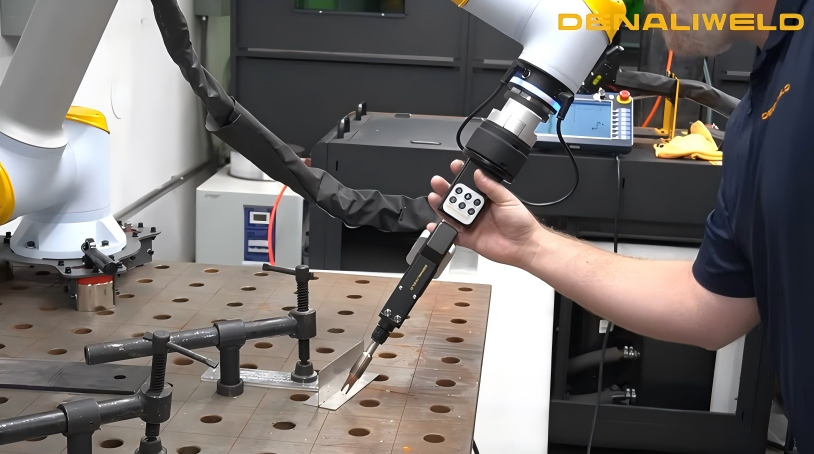
Understanding cobot welding components starts with one important point: a cobot welding setup is a complete system, not just a robot arm. A cobot is designed to work near people, but welding performance still depends on every part around the robot. Denaliweld’s cobot platform can serve as the foundation, but the full cell also includes weld delivery hardware, tooling, controls, safety equipment, and support systems. A system-level breakdown of the components that make or break cobot welding performance helps shops evaluate quality, usability, and deployment readiness before production starts.
What Counts as a Cobot Welding System?
A cobot welding system includes the arm, welding process equipment, mounting hardware, fixtures, software, safety layer, and surrounding support equipment. Buyers often focus on reach, payload, or programming ease first. Those details matter, but they do not tell the full story.
System performance depends on how well the parts work together. The arm must move smoothly, the weld source must deliver stable output, and the tooling must hold parts in a repeatable position. Arc welding and laser welding cells may share the same basic logic, but their delivery hardware and safety needs can differ. Shops comparing platforms can use Denaliweld’s guide on how to choose the right cobot as a supporting resource for early planning.
Core cobot welding components That Directly Affect Weld Performance
The most important cobot welding components are the ones that directly affect weld quality, access, repeatability, and uptime. The cobot arm controls motion. The power source or laser source controls process output. The torch, welding head, or end effector delivers the weld at the workpiece. Tooling controls part position, while cables, hoses, mounts, and controls keep the system stable during repeated cycles.
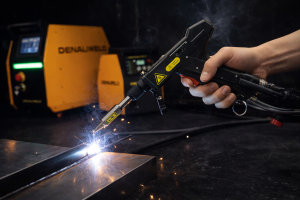
For laser-based configurations, the Denaliweld Air-Cooled 3kW Laser Welding Machine may be part of the equipment stack. In that setup, the laser source, beam delivery path, optics, and safety controls become critical cobot laser welder parts. These parts need to work with the cobot motion platform, not around it.
Component | What It Controls | Why It Matters |
Cobot arm | Reach, motion, repeatability | Affects joint access and consistency |
End effector | Weld delivery point | Affects torch angle, beam delivery, and access |
Power or laser source | Process output | Affects penetration, stability, and speed |
Tooling | Part location | Affects repeatability and setup time |
Controls | Communication and recipes | Affects usability and troubleshooting |
Safety equipment | Work area control | Affects production readiness |
Robot Arm and Motion Platform
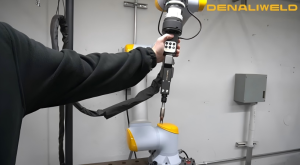
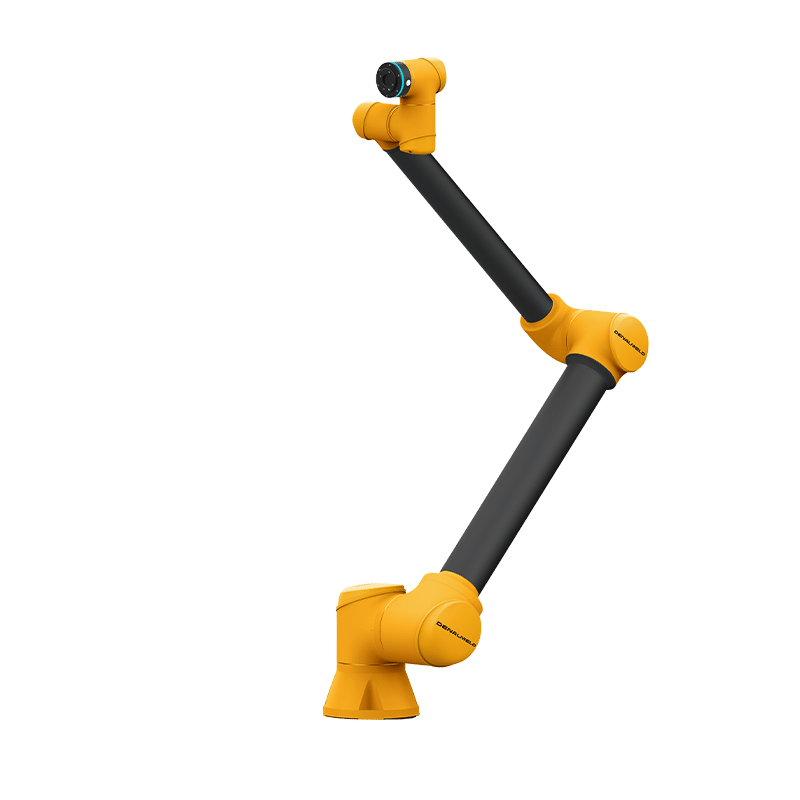
The robot arm sets the working range of the cell. Reach, axis movement, payload, and repeatability all affect how well the cobot can access joints. A strong arm specification does not guarantee good welds if the mounting position or workspace layout creates awkward angles.
Good motion planning reduces rework. It also helps avoid inefficient paths, poor torch positions, and cycle-time delays. The best setup lets the cobot approach the weld consistently without fighting the fixture, table, or surrounding equipment.
Welding Head, Torch, or Cobot End Effector
A cobot end effector is the component attached to the arm that performs the weld-related task. In arc welding, that may be a torch and wire delivery setup. In laser welding, it may be a welding head designed for beam delivery and process control.
This part is where software, motion, and the welding process meet the workpiece. Its design affects access, heat management, wire delivery, beam delivery, and part-to-part consistency. If the end effector is too bulky, poorly mounted, or difficult to align, weld quality can suffer even when the robot path is correct.
Power Source, Laser Source, and Process Delivery
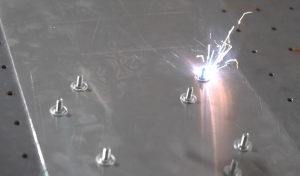
The weld source controls the energy behind the process. Stable output supports more consistent penetration, bead shape, travel speed, and operator confidence. Unstable output makes troubleshooting harder because the problem may appear to be motion-related when it is actually process-related.
Arc welding systems may include wire feeders, shielding gas, torches, and consumables. Laser welding systems may include beam delivery hardware, optics, gas support, and added exposure controls. Each setup should match the material, thickness, joint type, and expected production rhythm.
Why cobot welding tooling and Fixturing Matter More Than Many Buyers Expect
Cobot welding tooling is central to repeatability. It is not just an accessory. Fixtures, clamps, locating features, and workholding surfaces determine whether each part arrives in the same position before the weld starts.
Inconsistent fit-up can undermine a well-programmed cobot system. If the part shifts, the robot may repeat the same path perfectly and still produce inconsistent results. Shops with varied jobs may need flexible tooling that supports faster changeovers. Shops with repeat production may benefit from dedicated fixtures that reduce setup variation. The right choice depends on volume, part mix, setup time, and the value of repeatability.
Tooling Choice | Pros | Cons | Best Fit |
Flexible tooling | Supports varied parts and job changes | May require more setup control | Low-volume or mixed work |
Dedicated fixtures | Improves repeatability and speed | Higher upfront planning effort | Repeat production |
Software, Programming, and Operator Readiness
Ease of programming is one reason many shops consider cobots. Still, easy programming does not remove the need for welding knowledge. Operators must understand teach points, path tuning, travel speed, process parameters, and recipe control.
Good software helps teams save repeatable settings and reduce variation between operators. Clear interfaces, presets, and integration options can shorten the learning curve. Training also acts like a system component in practice. A strong hardware setup can still underperform if operators do not understand fit-up, torch angle, safety checks, or process adjustments.
Safety, Support Equipment, and Cell Integration
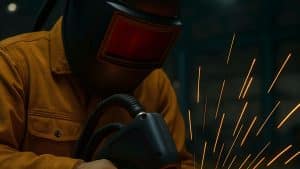
Safe cobot welding performance depends on more than collaborative motion features. Welding creates heat, light, fumes, sparks, and process-specific hazards. The cell may need guarding, curtains, extraction, power management, cooling, and organized access for maintenance.
Laser welding requires special attention to exposure control, visibility, and protective barriers. Cable routing also matters. Poorly placed cables and hoses can limit motion, create wear points, or make maintenance harder. Support equipment is often what separates a demo-ready system from a production-ready cell.
Structural Diagram: Cobot Welding System Flow
Part geometry → Tooling and fixture setup → Cobot path → End effector or welding head → Power or laser source → Safety and support equipment → Repeatable weld output
How to Evaluate the Right Component Stack for Your Application
The best setup depends on the job mix, not just headline specs. Shops should evaluate part geometry, material type, joint access, throughput goals, available floor space, and operator skill before choosing a system stack.
Think in terms of compatibility. The cobot, end effector, weld source, tooling, software, and safety equipment should support the same production goal. A high-value setup may cost more upfront if it reduces rework, shortens setup time, or improves uptime. Serviceability, training needs, and future scaling should also be considered before installation.
For varied fabrication work, flexibility may matter most. For repeat production, fixture quality and recipe control may drive more value. For laser welding, safety planning and source integration become especially important.
FAQs
What are the most important cobot welding components in a typical system?
The most important parts are the cobot arm, weld source, end effector, tooling, controls, safety equipment, and support systems.
What is the difference between a welding torch and a cobot end effector?
A welding torch delivers the arc or wire. An end effector is the full tool mounted to the robot arm, which may include a torch, welding head, brackets, sensors, or delivery hardware.
Which cobot laser welder parts are unique to a laser welding setup?
Laser welding setups may include a laser source, beam delivery hardware, optics, shielding gas support, and laser-specific safety barriers.
Why is cobot welding tooling so important for repeatability?
Tooling holds parts in a consistent position. Without a repeatable fit-up, the cobot can follow the same path and still produce inconsistent welds.
Do cobot welding systems still need safety barriers or curtains?
Yes. Welding hazards can include light, heat, fumes, sparks, and laser exposure, depending on the process.
How much operator training does a cobot welding system usually require?
Training depends on the process and application, but operators should understand programming, fit-up, weld parameters, and safety checks.
Conclusion
Strong cobot welding results come from the right system combination, not from the robot alone. The cobot arm, weld delivery hardware, tooling, software, support equipment, and safety layer all affect performance. When those parts work together, shops can improve repeatability, usability, and uptime.
Denaliweld helps fabrication teams think through cobot and laser-related solutions as complete production systems. For shops planning a new welding cell or improving an existing one, the next step is to evaluate the full component stack before choosing equipment.