

Small fabrication shops worldwide are experiencing an incredible shortage of skilled welders, and yet, the demand for high-quality welding production has never been greater. That is why fabrication shops of all sizes are turning to automation to help them fill the gaps in their skilled labor shortage.
However, the big dilemma amongst fabrication shop owners when upgrading to automation is whether to invest in cobot welding or traditional robot welding. In this article, we compare the safety, programming, and best use cases of cobot welding vs robot welding to help you choose the best small shop automation welding technology for your needs.
See whether handheld laser welders deliver professional results without a steep learning curve.
That question matters because most buyers are not only comparing weld quality. They are also weighing portability, ease of operation, compatible materials, productivity, and long-term support. This article looks at how handheld laser welders compare with traditional welding, which materials they work best with, the main pros and cons, and what to consider when choosing a system based on usability, weight, and warranty coverage.
Quick Definitions: Cobot vs Industrial Robot
Before making a comprehensive robot welding comparison, it is important to understand the core definitions of cobot welding and industrial robot welding so that you know the differences between these two types of automation welding.
Cobot Welding
Cobot welding refers to collaborative robot welding. It is basically a system where a robotic arm performs a particular type of welding, such as laser, MIG, or TIG, while working alongside a human welder. The cobot merely assists the human welder rather than replacing them. Safety sensors are built into the cobot to stop the motion of the arm and prevent injury if it bumps into another person or object.
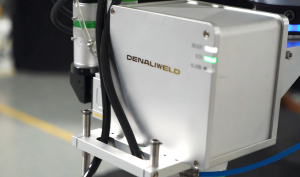
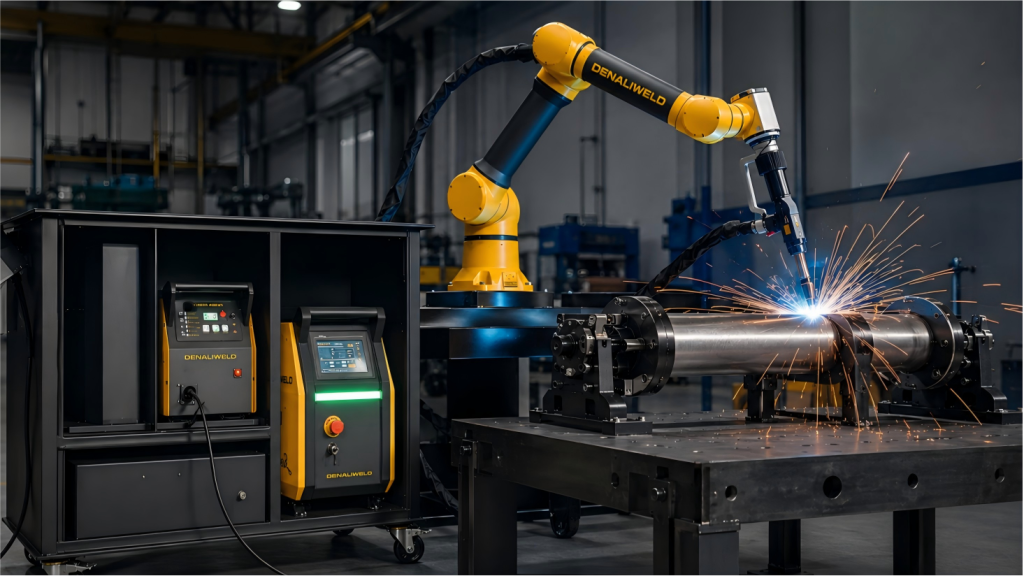
The DenaliWeld COBOT Laser Welding System is a good example of the ideal cobot welding system. It can easily integrate into fabrication shops of any size due to its mobility, user-friendly technology, and wide compatibility.
Industrial Robot Welding
Industrial robot welding is the traditional form of robot welding. It usually involves the use of several pre-programmed industrial arms that automatically perform welding jobs at high speeds. They are meant to automate the welding process by replacing human welders with robotics systems in a high-volume production environment.
Best Fit by Shop Size and Production Volume
A comprehensive robot welding comparison when choosing between a collaborative robot vs industrial robot. Each form of welding robotics technology can benefit fabrication shops of various sizes and production volumes.
For example, cobot welding benefits small shop automation. If you run a small fabrication shop where you need to weld dozens of custom metal objects per day, a traditional industrial robot welder would actually slow you down. You would spend so much time reprogramming the robot to accommodate the various custom requirements of each weld that it would end up reducing your production efficiency.
Cobot welding is better for custom welds in low-volume environments like this because cobots can be reprogrammed faster to accommodate more specific welding requirements. Not only that, but you can also move the cobot robotic arm from station to station more easily within your fabrication shop.
An industrial robot is more suitable for high-volume fabrication shops, where you might need to produce thousands of similar items per day. The robot is programmed to perform identical or nearly identical welds at top speeds to produce items quickly. Larger fabrication shops are more likely to use an industrial robot for this reason.
Safety and Workspace Needs
The amount of workspace you have available will be a critical part of your decision between cobot welding and industrial welding. Traditional industrial robots require a massive amount of workspace because they have more speed and power than cobots. Since this higher speed and power create more of a safety risk, a shop must use more safety fencing, doors, and designated welding zones to keep people separated from them.
A small fabrication shop will find it difficult to operate traditional industrial robots safely because it won’t have enough space available. Hundreds of square feet of floor space are needed, which a cramped fabrication shop cannot provide. A much bigger manufacturing facility is needed to satisfy the massive workspace requirements of industrial robots.
On the other hand, cobots are safer and easier to install in small fabrication shops because they are ultimately safe by design. A cobot robotic arm is attached to a welding cart that you can wheel around your shop easily. It doesn’t require that much space or safety measures like fencing. The only safety you really need to concern yourself with is the personal protective equipment when working alongside it.
Programming and Changeover Time
Programming a traditional industrial robot is no easy task. It requires a welding operator with specialized knowledge in a specific manufacturer’s programming or coding language to program the industrial robots. The operator must teach the robot how to perform specific tasks by creating logical sequences that map out every single waypoint of its physical operation. A skilled operator needs about 1 to 6 hours for manual online programming or up to two hours for offline programming.
It is generally faster to program a cobot than a traditional industrial robot. Cobots are smaller and come with user-friendly interfaces that make them easier to use for conducting specific tasks. A welder who doesn’t know anything about programming or coding can literally grab the cobot arm and physically move the welding torch to where they need it to be. The touchscreen apps allow a standard welder to operate a cobot without needing specialized knowledge in programming. It allows for much faster changeover time for cobots than industrial robots.
Decision Checklist
Are you still deciding between cobot welding vs robot welding? You must choose the right cobot for your needs and specifications. Here is a checklist to help you guide your decision:
Cobot Welding
- Small fabrication shops with low-volume production
- Custom welds with specific welding requirements
- Collaboration with a human welder
- Requires less floor space
- Empower human welders to use automation
- Lower upfront investment
- Easy to move around
Industrial Robot Welding
- Bigger manufacturers with high-volume production
- More similar welds with fewer custom setups needed
- More autonomous without human assistance
- Requires more floor space
- Works at high speeds
FAQs
What is the best way to think about a collaborative robot vs industrial robot?
A collaborative robot is more like a smart tool that assists a human welder in doing their welding job, whereas an industrial robot completely replaces the human welder with a fully autonomous one. If you have complex or custom welds, a collaborative robot with a human is more suitable for them to ensure they are done correctly.
Do cobots offer the same precision as traditional industrial robots?
Yes, a cobot robotic arm operates with incredible precision and speed. It can perform most standard TIG and MIG welding tasks with flawless results that match the same standards as traditional robotic welding.
Do I still need to wear safety gear when working alongside a cobot?
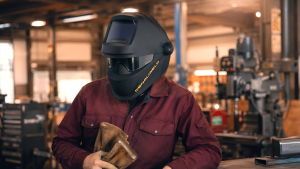
Yes, you should always wear safety gear next to a cobot. Even though it has safety features programmed into it, you still have to protect yourself from the light and fumes associated with the operation. That is why protective measures like PPE, curtains, screens, and fume extraction are still necessary to have available for your safety.
What is the most expensive option?
Industrial robots are more expensive because they require more safety precautions, higher quantities of robots, and the hiring of a specialized programmer to program them. Cobots are much more affordable for the average small fabrication shop owner because they don’t have such extensive programming requirements.