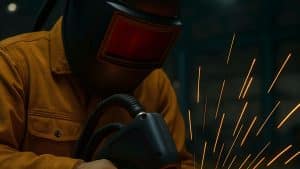


Labor is usually scarce for tasks that demand intensive knowledge and specialized skills. For instance, welding metals to complex geometries at high volumes requires highly-skilled workers who can produce flawless welds efficiently.
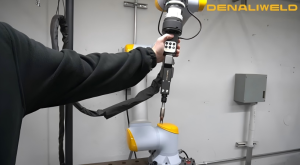
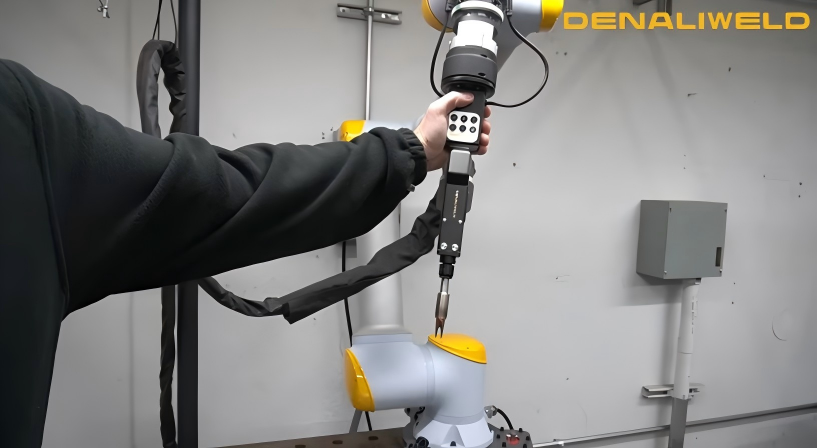
A cost-efficient and reliable alternative to highly-skilled labor is collaborative robots or cobots. These machines can work together with human staff to enhance the production’s speed, efficiency, and productivity. Currently, cobots are commonly used in welding workpieces in the aerospace, automotive, electronics, and medical equipment industries.
In this article, we guide you on how to choose the right cobot for your firm according to your project requirements and budget considerations.
Assess Your Welding Application Needs
You must define your welding application requirements prior to the selection of a welding cobot. When we say “application requirements, these include your project’s target production volume, the material type of your workpieces (e.g., are they made of stainless steel or aluminum?), and the complexity of the welds required. It is vital that your cobot meets these factors to ensure that you choose a solution that can satisfy your production goals with ease.
Do not forget to also consider your operation’s repetition levels and capabilities. Most cobots excel in both high and low-volume production environments, where they can maintain steady torch motion and consistent quality, even across different welding tasks. However, some cobots might have a maximum limit in the number of their welding iterations, which can disrupt your production workflow if your production requirements exceed your cobot’s limit.
Your chosen cobot must be easy to integrate as well. An easy-to-integrate cobot is often compatible with various welding equipment, such as both air-cooled and water-cooled laser systems. The better the ease of integration of a cobot, the more flexible it is to change workflow demands with minimal disruption.
Safety must also be considered. Choose cobots built with a force-sensing technology and high IP ratings (such as IP54 or IP65) to ensure that they come with adequate protection and safety precautions. A “safe-to-use” cobot can detect nearby human presence and respond quickly by slowing down or stopping its operation to prevent collisions, accidents, and injuries.
Key Technical Specifications for Welding Cobots
The performance of a welding cobot depends greatly on its technical specifications. If these specifications are set optimally, you can expect clean, high-quality, and durable welds from your cobot welder.
Here are the most important technical specifications for welding cobots.
Payload Capacity: This refers to the maximum weight that a cobot arm can safely carry. The cobot must have a payload that exceeds the total weight of your welding setup. An example of this machine is the Denaliweld cobot series. These cobots can support loads of around 5 kilograms to 16 kilograms, more than enough payload capacity to handle thin and thick metal workpieces.
Reach: This pertains to the maximum distance that the cobot arm can extend from its base. It is also called “effective radius” in some applications. Reach determines the largest part size the cobot can weld in a single setup. For instance, Denaliweld cobots have a reach of around 917 millimeters to 2000 millimeters.
Speed: This parameter refers to the rate at which the cobot’s end effector (the tool at the arm’s tip) can navigate, usually measured in meters per second (m/s). Higher speeds (such as 1.5–1.8 m/s) mean faster welding cycle times, which boost productivity for high-throughput welding tasks.
Axes and Flexibility: Count the number of independent axes or joints the cobot has. The higher the number, the more flexible your cobot is for various welding tasks. A cobot with at least six axes is ideal as it can support complex and multi-angle welds that can be installed in various positions.
Welding Process Compatibility and Features
Upon checking your cobot’s specifications, the next step is to check if its features are compatible with your current workflow system and existing equipment.
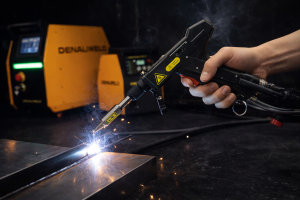
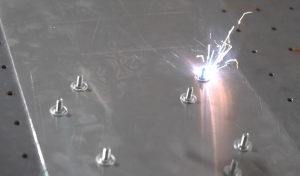
Say that you are working with thin workpieces that must be welded into complex sheet geometries. Fiber laser welding is the ideal solution for this task as it offers superior precision and minimal thermal distortion. Hence, your chosen cobot must support laser welding by having some key features such as an efficient cooling system (air-cooled or water-cooled), Input-output ports, laser control interface, and safety interlocks.
It is also recommended to choose cobots that have modular features that enable easy and flexible augmentation of components or workflows. For instance, some modular cobots allow quick and easy upgrading from an air-cooled to a water-cooled laser welding head by swapping out the mounting bracket and connecting additional cooling lines.
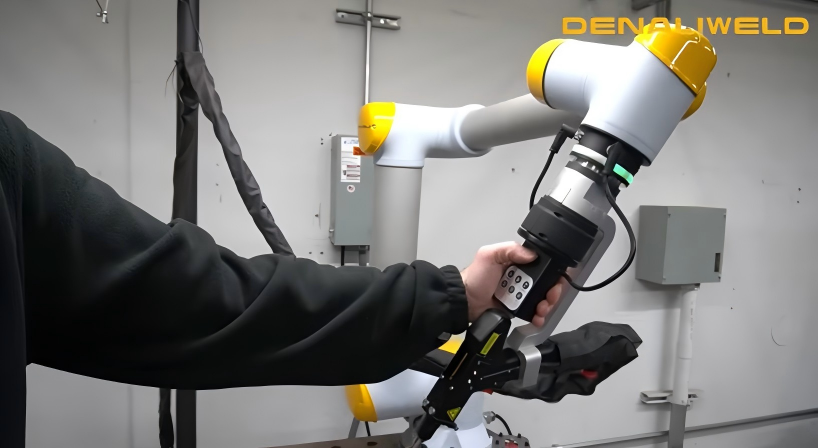
Another important consideration is the cobot’s user interface. The UI is the cobot’s main control point to program and operate it, usually via a handheld device or computer. An easy-to-use cobot interface allows quick and easy adjustment of welding paths and routines that can help you streamline and fast-track your welding project.
DenaliWeld COBOT Advantages and Implementation
Denaliweld Cobot laser welding system comes with top-tier features and technical specifications that meet modern industrial welding standards. These cobots are independently developed by leading engineers and laser technology experts for a reliable and high-performing modern welding solution for the automotive, aerospace, electronics, medical equipment, and fabrication sectors.
Denaliweld cobots come with modular engineering for uncomplicated maintenance, quick repairs, reduced downtime, and enhanced productivity. And through their seamless automation integration features, these cobots can support a rapid transition from Cobot mode to robot automation using the DENALIWELD ROBOX™ system.
Furthermore, Denaliweld cobot units have automatic welding heads (GCR 5/10/16) that enable real-time power adjustments throughout the welding process for enhanced precision and quality. And they also feature optional seam tracking systems that promote precise weld alignment and improved accuracy.
Finalize Your Cobot Choice Toward Improved Efficiency and Productivity
When you acquire a cobot, you do not blindly pick one and move on. Your cobot choice must be based on stringent consideration of the unit’s technical specifications, features, and compatibility with your current production system. Make sure that your cobot’s capabilities can meet your project requirements to ensure a worthwhile investment.
Denaliweld is a global laser welding brand that develops cutting-edge cobot technologies. Our cobots offer best-in-class performance with features and specifications that meet modern industrial standards. With Denaliweld cobot’s user-friendly interface, intelligent operation, reliable safety features, and maximum operational flexibility, this machine can level up your firm’s productivity and efficiency.