

Compared to traditional robotic machines, cobots are designed for high-level performance and safe human interaction. With its intuitive controls, compact footprint, and built-in safety features, it can enhance your firm’s productivity without the risk of staff injuries or accidents.
These astounding feats of cobots are the reason why many industries have started to adopt this technology. Cobots are now highly effective and reliable in welding, assembly, and material handling.
In this article, we explore common cobot applications across modern industrial welding sectors.
What Are Cobot Applications in Welding?
Cobot welding is a superior welding solution in terms of adaptability, precision, reliability, and flawlessness. A collaborative robot or cobot can handle common welding processes such as TIG, MIG, and laser welding with remarkable millimeter-level accuracy. These robotic machines also excel in performing repetitive tasks like seam welding on sheet metal. For this reason, they can significantly reduce human errors and ensure consistent, high-quality welds.
Now, how do cobots work?
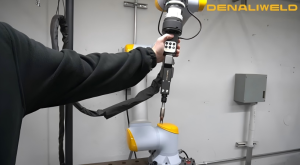
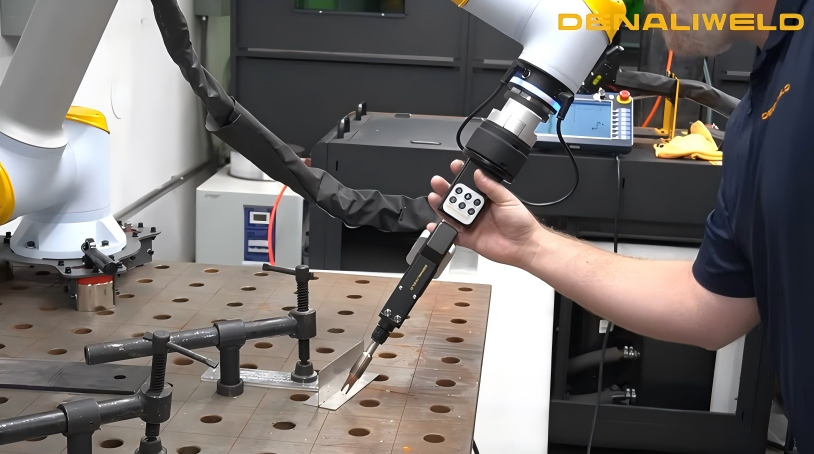
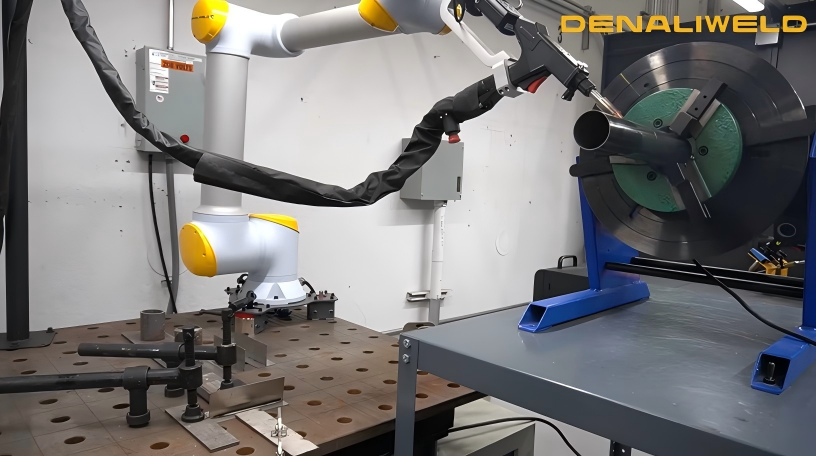
Every cobot welder comes with a robotic arm that is equipped with a specialized welding torch (which must be suited for the specific welding task). This arm moves by following the guidance of the cobot’s programming. A set of programmed instructions powers the sensors and controllers, which in turn move the arm.
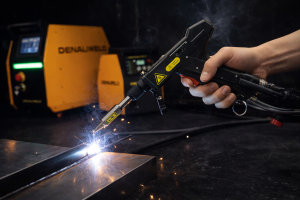
A cobot system also commonly features a power source that maintains a stable set of welding parameters, a wire feeder for MIG/TIG operations, and an intuitive teach pendant. For laser welding, the setup includes a precise laser source and advanced optics to deliver focused energy exactly where it is needed. These teach pendants feature drag-and-drop programming, which enables the operators to set up new welding routines for laser, TIG, or MIG processes with ease.
Key Benefits of Cobot Welding
The use of cobot welding has a lot of upsides in industrial welding processes. In particular, cobot welders can deliver immense productivity gains to the manufacturers since they can operate 24/7 at a consistent speed and performance. Even if the task requires complex geometries and intricate specifications, the cobot welder can still produce them with uniform quality and absolute efficiency.
It is estimated that cobots can maintain welding speeds of around 20 to 30 inches per minute. This is at least twice the rate of a skilled human welder. Hence, when a cobot and a seasoned welding operator work together, they can fast-track production at least five times faster compared to a setup where only human workers perform the weld.
Most cobots are also equipped with advanced collision detection and force-limiting sensors so they can operate safely alongside human workers. These features minimize the risk of injury and ensure compliance with ISO-10218 safety standards for industrial robots. For this reason, cobot welding systems do not require large and bulky safety barriers, cages, or enclosures.
Compared to other advanced welding technologies, cobots are also generally more cost-effective in the long run. They have lower upfront installation costs since they do not need extensive physical barriers. Their intuitive and user-friendly interfaces also shorten staff training times from weeks to just a few days, which drives down a firm’s operating costs.
Common Cobot Applications in Welding Environments
A lot of modern manufacturers have adopted welding cobots for tasks that demand high precision and consistency.
In the automotive sector, many cobots come with TIG, MIG, and laser welding technologies to weld and fuse critical vehicle components such as suspension brackets, exhaust assemblies, and chassis subframes. These applications require weld seams within tight tolerances (around ±0.5 mm), where cobots excel due to their consistent torch travel speed and precise arc control.
In the electronics industry, cobot laser welders are often applied for constructing delicate enclosures and circuit board shields. This is because cobots can wield a laser beam with high precision and weld with minimal heat-affected zone (HAZ), which ensures superior protection for sensitive electronic components. These robots are also useful in the production of welding battery tabs, connectors, and micro-cases for devices like smartphones, computers, and tablets.
Cobots are also applied in the manufacturing of heavy equipment, such as construction machinery and agricultural vehicles. Cobots tackle high-deposition MIG welding on large-scale frames, loader arms, and support brackets. These applications require the cobot to handle heavy parts as well as to load and unload jigs or fixtures. These cobots also apply seam tracking for accurate weld placement on thick-section materials.
And one of the most important cobot applications is in medical equipment and device manufacturing. Cobots can produce sterile, hygienic, and durable surgical instruments such as forceps, scissors, and clamps, where laser welding produces precise and clean joints in stainless steel with minimal thermal damage. They can also create implantable devices like pacemaker housings, bone plates, or dental implants with top-level longevity and sanitation.
Implementation and Programming Cobot Welders
Upon recognizing various cobot applications, it is now time to augment this tech to your workflow. In this section, we help you implement and program cobot welders.
Start with a risk assessment to see if cobots are safe to use in your facility. You may refer to the OSHA and ISO safety guidelines for this phase. In this process, you identify hazards and evaluate potential safety risks. Use checklists to ensure you address pinch points, electrical exposure, and fume risks, then document all your findings.
Next is to acquire a cobot welding machine from a reputable supplier. Choose a manufacturer whose products meet stringent international safety standards and have a good reputation for performance and efficiency. For instance, Denaliweld produces world-class cobots that are SGS, CE, and WPQR-certified. This brand specializes in the production of advanced laser welding solutions for modern industrial applications. With hundreds of positive reviews and over 3000 customers annually, Denaliweld tops the market for modern laser cobot welders.
Now, you may start programming the cobot. Use the handheld interface, which provides a touchscreen or joystick for step-by-step instruction. Move the cobot arm to each welding point. Save each position as a waypoint. Afterward, assign welding parameters (e.g., speed, voltage, and current) at each location according to your project requirements.
Challenges and Future Trends in Cobot Welding
Of course, cobot welding has some limitations and challenges. For instance, the upfront cobot investment is a huge hurdle for many businesses, especially small and medium-sized enterprises (SMEs). Cobots indeed reduce costs in the long run because of their efficiency and fewer errors. But the cobots’ initial purchase, installation, and training expenses can be significant.
Another common limitation is the performance constraints of a cobot welder. They usually operate more slowly than traditional industrial robots and may not be compatible with high-volume production lines where speed is critical. But for custom or small-batch jobs, these limitations rarely hinder productivity.
Achieve Best-in-Class Cobot Applications For Modern Industries With Denaliweld
Cobot welding is effective and reliable in enhancing welding efficiency, safety, and scalability. With the correct specification and programming, a cobot welder can transform your firm’s productivity and level up its output capacity. Currently, cobots are applied in the automotive, aerospace, electronics, and equipment production industries.
Here in Denaliweld, we strive to bring out the industry-leading cobot welders that will propel your firm’s production capabilities. Our cobot welding solutions are CE/SGS/WPQR-certified and designed to meet modern industrial demands. And with its basic cobot programming features and intuitive interface, you can use it with ease in no time.