

In modern industrial production lines, two things are paramount – productivity and worker safety. The absence of any of these aspects can undermine the firm’s competitive edge. For this reason, manufacturers seek innovative technologies that can elevate both aspects.
One of such innovations is collaborative robot welders. This equipment uses robotic arms to perform repetitive seam work and fuse complex joints with pinpoint accuracy.
Discover in this article what collaborative robot welders are, as well as their strengths and use cases.
How does a cobot welder differ from a standard laser welder?
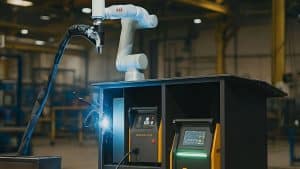
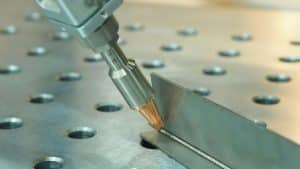
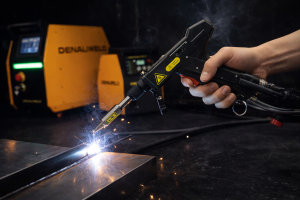
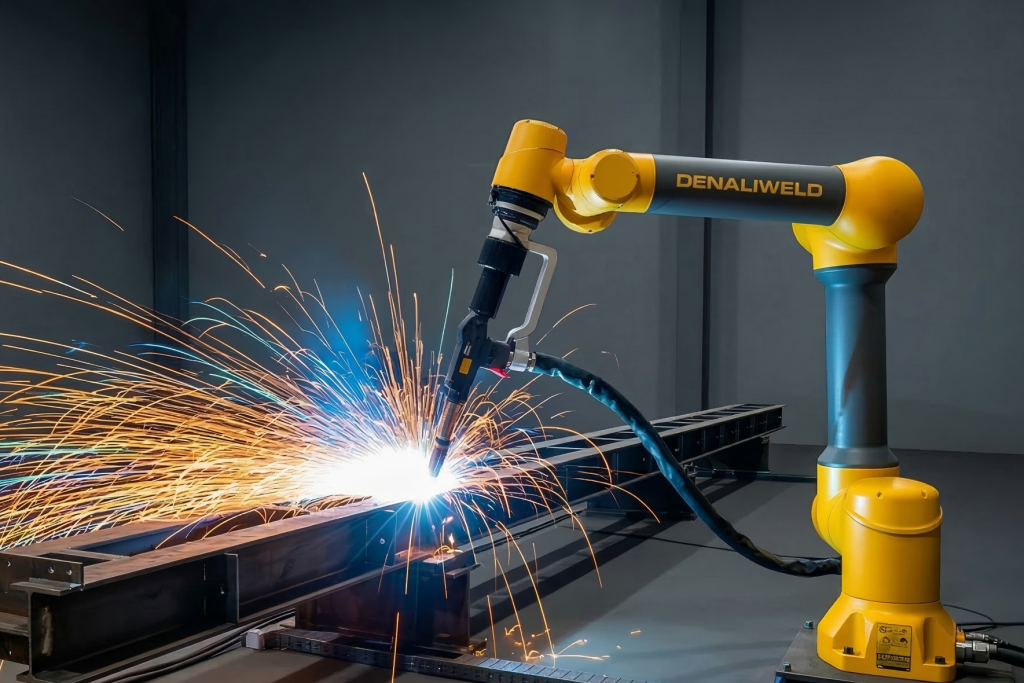
A cobot welder comes with a robotic arm equipped with a welding head, which can be a laser or MIG weld torch. It also features built-in force, motion, and collision sensors that enable it to operate safely near human workers. In contrast, a standard laser welder is typically a stationary unit fixed to a workbench or enclosed cell, designed for fixed-position welding tasks. Usually, it requires physical isolation from operators during operation.
Some of the key differences between the two welding technologies are as follows:
- Mobility and Adaptability: A cobot welder can navigate across multiple joints and component geometries because the robotic arm provides programmable multi-axis motion. You can reposition, reprogram, or redeploy a cobot unit in different stations as production needs change. Meanwhile, Standard laser welders are generally optimized for high-volume and repetitive welds, but in a fixed setup.
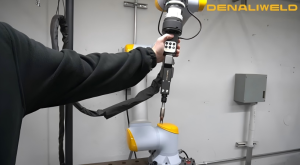
- Programming and Usability: Cobot welders often feature intuitive operation, hand-guiding mechanisms, or teach-by-demonstration capabilities. An operator can physically guide the robotic arm along a weld path and save the motion, which makes the welding tasks relatively faster. Standard industrial laser welding systems, on the other hand, frequently require specialized programming knowledge and technical configuration, which can lengthen setup time and increase dependency on skilled technicians.
- Production Strategy: Cobots are well-suited for high-mix and low-to-medium-volume environments where product designs change often. Their quick reprogrammability allows manufacturers to switch between jobs efficiently. On the other hand, standard laser welders are ideal for repetitive and high-volume production operations where the same weld geometry is performed continuously, and maximum throughput is the priority.
Which cobot welders are best for small workshops?
Cobots require sufficient space to perform efficiently. Hence, if you have a small workshop, it is crucial to consider whether your limited floor space can support a highly mobile and flexible cobot welder or not.
For small workshops with limited floor space and multiple project demands, the cobot welder must be compact and easy to deploy. This ensures that it is capable while having low overhead.
Then, choose collaborative robotic arms with a small footprint and intuitive interfaces that can operate in space-constrained environments without the need for large safety cages or extensive infrastructure modifications. These cobot units typically feature lower upfront costs and can be deployed and programmed quickly (often in under an hour), and scale well for teams of 1 to 10 members who handle custom fabrication, repair, or prototype runs.
To boost your workshop’s flexibility, you may also consider cobot welders that have wheeled bases for mobility, which allows the system to move between stations. The operator can simply push the machine to relocate it if the project demands.
In real-world use, cobot welding setup excels at tasks like tacking seams on automotive body panels or structural brackets, where they deliver consistent results without requiring a full factory reconfiguration. For shops juggling varied part geometries and run lengths, you can choose a compact cobot that emphasizes portability, simplicity, and adaptability to maximize productivity and minimize complexity and cost.
Which cobot welders are safest to use near humans?
Cobot welders operate in environments where human-machine cooperation thrives. Under these conditions, safety is of utmost priority. Cobot welders that are designed and certified to meet collaborative robot safety standards such as ISO/TS 15066 are one of the safest pieces of equipment to operate near humans.
ISO/TS 15066 stipulates force and pressure limits, human-robot interaction zones, and risk assessment practices for collaborative operation. Models that adhere to this standard incorporate multiple layers of protection, such as force-limiting sensors, built-in emergency stop circuits, and automatic speed reduction when a human enters a shared workspace. This setup ensures a predictable, calculated, and safe robotic behavior without relying excessively on physical barriers.
Consider Denaliweld’s cobot machines, which are engineered from the ground up for collaborative laser welding. Denaliweld systems integrate sensitive joint torque monitoring and collision detection algorithms that pause motion at the first sign of unexpected contact. Since these cobots are inherently force-limited and capable of dynamic speed modulation based on proximity sensing, they can operate without traditional fencing in defined collaborative zones.
What are the Leading Brands of Cobot Welders?
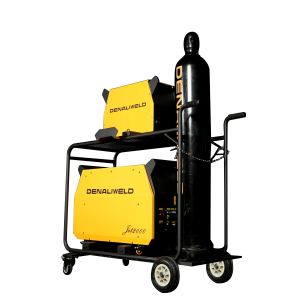
Currently at the forefront of welding innovations, Denaliweld is a leading brand that provides welding-focused cobots with integrated laser technology. Denaliweld Cobots feature advance automation system, a simple user-interface, pre-set laser parameters, and channels for flexible integration across multiple platforms.
And with Denaliweld cobots’ one-click switching feature, you can easily transition between Cobot and robot automation using the DENALIWELD ROBOX™ system. Upon selecting the automated mode, it will utilize an Automatic Welding Head (GCR 5/10/16), which enables real-time power adjustments throughout the welding process for enhanced precision and quality.
Furthermore, Denaliweld Cobots offer best-in-class performance to meet the demands of modern manufacturing with the following features:
- Lightweight and Flexible Design: Augment Denaliweld cobot with ease into various production lines for a versatile welding solution for a wide range of applications.
- Enhanced Safety and Speed: With industry-leading welding speeds and advanced safety features and controls, DenaliWeld cobots can help you achieve efficient production while maintaining a safe working environment for human operators.
- Cost-Effective Investment: With DenaliWeld cobots, you can access affordable automation without compromising quality. The brand’s cobots deliver a high return on investment by reducing labor costs and increasing output.
Which cobot welders are easiest to program?
The easiest cobot welders to program are cobot units that support teach-by-demonstration through a process called lead-through programming. In this approach, the operator guides the robotic arm manually along the weld path, records the movement, and saves it as a repeatable program. There is no need to write code as the system remembers the demonstrated actions by the operator. The machine will then perform these actions during the welding process.
As the cobot converts the guided motion into executable instructions, the machine can easily reduce technical barriers to automation. Some units even allow users to generate a full welding sequence simply by moving the arm through the desired waypoints and confirming them in the interface.
Use Cases and Best Practices
Whether it is for small or medium-sized firms, cobot welders become increasingly valuable to achieve superior consistency and productivity in high-volume production lines.
For instance, small automotive firms often use cobots to weld components such as brackets, chassis reinforcements, or body panels in limited quantities. A cobot welder can handle repetitive seam tacking or precision welds on structural components while the technician focuses on alignment, inspection, and finishing work.
Another typical cobot application is furniture and metal fixture fabrication. Manufacturers producing steel furniture frames, shelving systems, or decorative metal structures frequently work with recurring weld joints across multiple product designs that cobots can easily achieve.
Meanwhile, in the medical device manufacturing, cobot welders can support the production of stainless steel or aluminum components that need controlled heat input and clean weld seams.
Wrap Up: Invest in Collaborative Robot Welders for Enhanced Production Capabilities
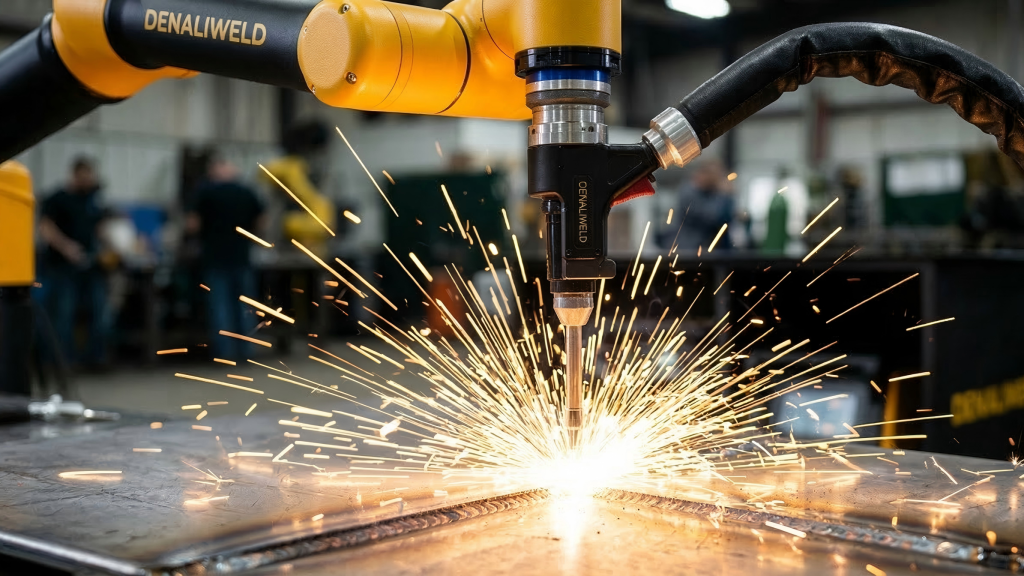
Collaborative robot welders, or cobots, offer the best of two worlds. These units can supercharge your production with their absolute speed, precision, and repeatability. Yet, it also guarantees safety and reliability when working alongside human operators.
For industry-leading laser collaborative robot welders, consider Denaliweld. We are a global laser welding brand that prides itself on its multiple innovative patents for superior laser welders that are all CE/SGS/WPQR-certified.