

Introduction
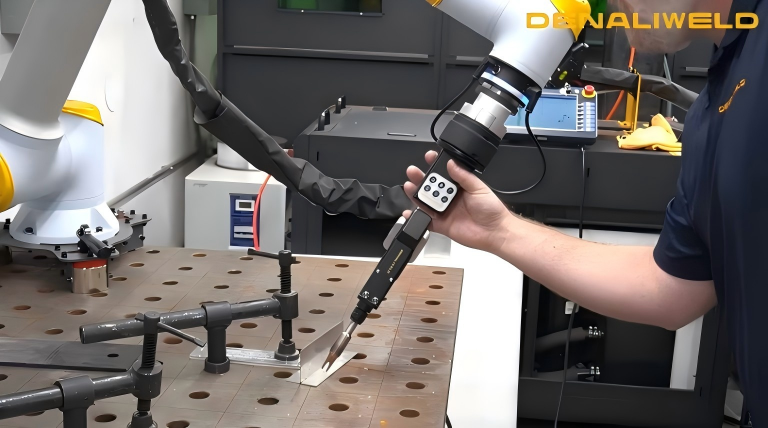
Flexibility, precision, robustness, and user-friendliness are some of the most important points of cobot laser welders. And these remarkable features helped mark these technologies’ place in the modern production industry.
But given these impressive features, should we expect sky-high cobot welding costs?
In this article, we break down the cobot welding system cost to help you see if this technology is worth the bucks. We did the math, from the initial purchase to operational overheads. Check out also why experts see ROI potential under 24 months based on industry benchmarks.
Denaliweld Cobot Upfront and Overhead Costs
When it comes to cobot laser welders, Denaliweld is a huge name. With its cobots’ impressive performance and pinpoint accuracy, it stands as one of the leading providers of laser welding solutions across the globe.
The cost of a Denaliweld cobot welding system covers both initial equipment costs and integration overhead. It can be considered that the upfront cost is significant, yet it is highly cost-effective due to its fast yield and ROI
Below is a realistic cost breakdown based on current industry benchmarks.
Base Hardware Costs
The core cost of a Denaliweld cobot welding system typically falls around $50,000 to $150,000, depending on the unit’s payload capacity, reach, and welding configuration. The base system of the units includes the collaborative robotic arm, hardware and software controller, welding power source (MIG or laser compatible), robotic welding torch, standard safety package, and basic programming interface.
For small to medium-sized metal fabrication shops, the basic Denaliweld cobot welding system can be acquired for as low as $75,000.
Integration and Overhead Costs
Beyond the unit’s base hardware, the firm must also consider the cost of integrating the unit into the assembly line.
- Physical Site Preparation: This includes the preparation of the welding table or custom fixturing, safety fencing or light curtains, any upgrades in the electrical wiring system, and adjustments in the area’s ventilation. The cost for physical site preparation is around $7,500 to $15,000.
- Programming and Setup Fees: Cobot systems are designed for fast deployment. Expect 4 to 20 hours of programming preparation with a cost of around $100 to 200/hr. Note that simplified interfaces and pre-configured welding packages often reduce programming time compared to traditional industrial robots.
- Shipping and Installation Costs: With many suppliers, shipping and installation can add 5–15% of the total system cost.
Component | Estimated Cost | % of Total |
Cobot Arm + Controller | $30K-$60K | 40-50% |
Welding Power Source/Torch | $15K-$25K | 20-25% |
Integration/Fixturing | $10K-$20K | 15-25% |
Software/Training | $5K-$10K | 10% |
Total Overhead | $60K-$115K | 100% |
Integration Challenges and Hidden Overhead for Denaliweld Cobots
Denaliweld cobots are designed to be integrated with ease into an existing production line. But even with a streamlined collaborative system, cobot integration involves more than just placing and positioning the cobot on the shop floor. You must expect some integration challenges, and overhead may increase the overall cobot adoption costs.
Here are some integration challenges to be considered:
(1) Electrical Upgrades: Most cobot systems require dedicated power circuits and a voltage stabilizer for consistent electric flow and proper grounding. Depending on existing infrastructure, electrical upgrades can cost up to $2000.
(2) Ventilation and Fume Extraction: Laser welding systems demand proper ventilation and fume extraction to meet workplace standards. For production lines, upgrading from manual welding may require high-efficiency fume extractors, ventilation duct modifications, and airflow balancing infrastructure.
Meanwhile, some of the expected integration overheads are as follows:
(1) Programming and Training Overhead: Traditional industrial robots often require specialized programmers and days (or weeks) of configuration. Unfortunately, this can significantly drive up cobot integration costs. By contrast, Denaliweld cobots come with intuitive touchscreen interfaces, drag-and-teach functionality, and pre-configured welding parameters to reduce the initial programming process from days to hours.
(2) Safety Compliance Costs: Collaborative robots are designed to operate safely alongside humans under standards such as ISO / TS 15066. However, many units still lack features that are necessary to be compliant with safety standards, such as force sensors, collision sensors, area scanners, light curtains, and partial safety fencing. By contrast, Denaliweld’s collaborative robots come with architecture that can minimize these add-ons compared to traditional six-axis industrial robotic cells, which typically require full enclosures and more extensive guarding.
Ongoing Maintenance and Management Costs
As with any industrial machine and equipment, cobots are vulnerable to wear and tear, technical errors, and gradual performance decline. While cobot welders reduce labor dependency and variability, they still incur recurring costs related to service, consumables, and system management.
For instance, Denaliweld service contracts cover normal wear in the mechanical joints, welding components, and laser optics of the cobot unit. Typical annual Denaliweld service contracts are estimated to be around 3 to 5% of the system purchase price for basic units. And for a $100,000 system, the estimated cost is around $3,000 to $5,000 per year.
Service coverage of Denaliweld units includes robotic arm calibration, drive and joint inspection, laser optics cleaning, power source diagnostics, and software health checks. And in certain cases, replacement of minor wear components is also performed.
Meanwhile, even automated welding systems rely on consumable materials. For a cobot unit that is operating at a rate of approximately 2,000 production hours per year, typical consumable costs include welding wire, shielding gas, contact tips, nozzles, and lenses.
For a $100,000 Denaliweld system unit, the yearly recurring costs of maintenance and upkeep are as follows:
- Maintenance service: $3000 to $5000
- Consumables: $2000
- Energy (efficient vs. traditional): $1000
This means that the estimated total maintenance cost of a unit is around $6000 to $8000 per year.
Cobot Welding ROI: Denaliweld's Long-Term Value
Now that you have a glimpse of cobot welding costs, the next thing to consider is the potential cobot welding ROI from this investment.
Mathematically, ROI is defined as the sum of labor savings and productivity gains divided by the total costs of the equipment.
(Labor Savings + Productivity Gains) / Total Costs
In the formula above, Labor savings pertain to the cost of replacing manual labor, reduced scrap and rework, improved productivity, and lower downtime. For instance, Denaliweld cobot systems can reduce direct manual labor hours while maintaining or increasing output levels.
Productivity gains, on the other hand, pertain to the measurable improvements in output, efficiency, and quality achieved without increasing proportional labor or operational costs. For instance, productivity gains in a Denaliweld cobot system come from several factors, such as when automated welding delivers consistent travel speed and arc stability and eliminates fatigue-related slowdowns that typically happen in manual welding.
In a typical case where one full-time welder employee is replaced (by the cobot), savings from manual welding costs is approximately $80,000 to $85,000 annually, including benefits. This results in around $253,000 over three years. By comparison, a Denaliweld cobot system may require an initial investment of about $100,000 with annual operating costs around $7,000, totaling approximately $147,000 over three years. This produces a net savings of roughly $106,000 within that period.
Moreover, Denaliweld cobot systems further elevate ROI through their integration flexibility, such as compatibility with handheld laser welding solutions. This allows manufacturers to use the same ecosystem for both automated production runs and precision manual applications. This results in an increase in asset utilization and a reduction of idle time.