

A small fabrication shop traditionally uses TIG and MIG welding methods for metal fabrication. Each one differs in terms of speed, precision, application, and skill level. The only places you would find laser welders were large industrial and manufacturing facilities due to their enormous size.
However, over the last decade, handheld laser welders have become more readily accessible for small fabrication shops. They are smaller, faster, and more affordable to complete the average metal fabrication job. If you haven’t acquired a handheld laser welder for your small shop yet, you are probably wondering what it can actually do compared to TIG and MIG welding.
In this article, we will explore the best handheld laser welder applications for small shops based on real-world laser welding examples.
What jobs are handheld laser welders great for
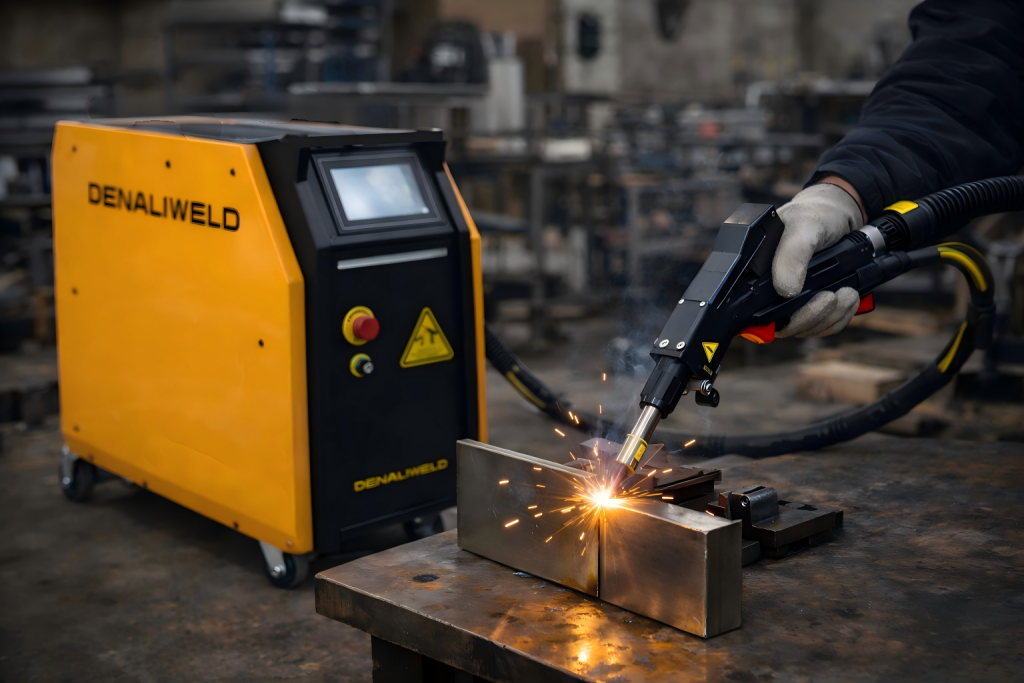
A handheld laser welder uses a highly concentrated heat source to perform high-precision welding with less warping and distortion. Because of this, the ideal laser welding projects are those with thin sheet metal, such as 18-gauge or 20-gauge stainless steel. Thin sheet metal fabrication is often used for metal enclosures, joints, railings, HVAC components, and other small metal parts.
In addition to its high power density and concentration, the laser welder can rapidly heat and cool, minimizing the heat-affected zone. That is why laser welding is more effective at joining dissimilar metals than traditional arc welders like MIG and TIG. You could join various metals, such as aluminum and steel, or copper and stainless steel.
What are the best laser welding projects? A small fabrication shop could use handheld laser welders for projects involving commercial kitchen equipment, architectural metalwork, medical device manufacturing, jewelry repair, automotive repairs, furniture repair, and other structures or devices that require structural component repairs.
Laser Welding Examples: brackets, frames, cabinets, tubes
Here are the four most common laser welder use cases:
Brackets
Metal brackets are frequently used hardware components used to stabilize, reinforce, support, and connect the parts of furniture, shelves, machinery, tables, cabinets, frames, and other construction materials.
A small fabrication shop would normally weld metal brackets with a TIG welder, but that process is usually slower. A handheld laser welder can weld metal brackets about four times faster than a TIG welder. It doesn’t pull the material like TIG welding does, which means you can skip the post-weld straightening phase.
Frames
Most built structures, from coffee tables to bicycles and automobiles, have metal frames to sustain their stability and durability. They are often tubular frames that require precise metal joints. A handheld laser welder provides efficient, precise metal fabrication of the frames without compromising their integrity.
Cabinets
Cabinets contain several metal components, even if the primary construction material is wood. These components include hinges, knobs, handles, drawer slides, and locks. TIG welding these components requires immense skill and experience to prevent warping. But if you use a handheld laser welder, you don’t need nearly as much welding experience to perform a precise weld without warping.
Tubes
Handrails and other tubular assemblies, such as pipes, are suitable for laser welding projects. Laser heat can penetrate the joints just enough to fuse the tube metal without requiring a wide bevel, as you would need with traditional arc welding. The result is smaller, cleaner welds.
What materials does laser welding typically work best on
Handheld laser welder applications work best on carbon steel, stainless steel, and aluminum because of their low distortion and high absorption rates. You could also use a handheld laser welder on titanium, copper, and nickel alloys, but it will require more power for a successful weld.
Projects that are not a good fit (and why)
Not all welding projects are suitable for handheld laser welder applications. Ideal laser welding projects use thinner metals with cleaner surfaces. If that doesn’t describe your welding project, then you might not want to use a handheld laser welder on it.
Here are some examples of welding projects unsuitable for handheld laser welding:
- Heavy-Duty Structural Welding Projects– Major welding projects, such as pipe fabrication and shipbuilding, use metals thicker than 0.5 inches. They are not suitable for handheld laser welders due to their low penetration depth.
- Large-Scale Welding Projects– Mass metal fabrication projects take too much time and energy when using handheld laser welders, as they require manual operation rather than automation. Plus, you would have a more difficult time moving around the larger, heavier components associated with mass metal fabrication.
- Projects Involving Narrow, Inaccessible Spaces – Some welding projects require you to access tight, hard-to-reach spaces to reach confined, inaccessible joints. A handheld laser welder cannot fit into or reach narrow spaces the way a TIG torch head can.
Before-and-after: finishing time and appearance
Labor is traditionally the biggest expense in a small fabrication shop. Traditional welding requires a lot of prep work, filler metal, broad heat-affected zones, and post-weld grinding and polishing.
The great thing about handheld laser welder applications is that they reduce the time and labor required for projects, resulting in lower costs. Since a laser welder runs continuously, it can penetrate 3mm stainless steel at a rate of 0.5 to 1.5 meters per minute. That is at least five times faster than TIG welding, which requires 0.1 to 0.25 meters per minute.
For instance, let’s say you were welding a stainless-steel corner for a pharmaceutical hopper. If you were using TIG welding, you could expect 10 minutes for the weld itself, 15 minutes for the grinding, and 20 minutes for polishing. If using a handheld laser welder, the weld would take about 2 minutes, 0 minutes for grinding, and 5 minutes for polishing.
The appearance comes out much better with handheld laser welder applications because you don’t need to grind down the bead flush. That saves considerable time and energy.
Tips to get consistent results on real parts
Here are some additional tips to help you achieve consistent results on your handheld laser welding projects:
- Maintain Cleanliness– Thoroughly clean the metal surface area to remove all paint, rust, grease, oil, and other debris. That will help prevent defects and spatter during welding.
- Use Clamps– Keep the metal material firmly held in place by securing it with clamps and fixtures. It is the best way to maintain consistent alignment during the weld without worrying about any accidental movement or distortion.
- Stay Safe– Wear specialized laser safety glasses (OD6+ rating) over your eyes to protect them from damage. These glasses should have polycarbonate lenses with side shield protection.
- Learn the Wobble – Most handheld laser welders allow you to adjust the laser beam width (or wobble). A narrower laser beam is useful for deeper penetration, while the wider beam is good for bridging gaps and improving aesthetics. Try practicing with different wobble settings to understand how they perform.
FAQs: Capabilities, limits, and expectations
How thick can the metal be?
Depending on the metal type and power level, a handheld laser welder can weld metals up to 4-6mm thick for repair and fabrication projects.
Is it difficult to learn how to use a handheld laser welder?
Not at all. An experienced TIG or MIG welder can usually grasp how to use a handheld laser welder within minutes. Someone with little to no welding experience may need 30 to 60 minutes to learn the basics. Of course, practice is recommended to improve your skills at handheld laser welding.
Is a handheld laser welder a replacement for TIG and MIG welding?
Not for all projects. A handheld laser welder is best for metal fabrication tasks that require greater precision and less distortion. For instance, if you need to perform pipe welding, you should still stick with a traditional welding method like TIG. But if you’re repairing a cabinet’s metal components, a handheld laser welder is faster and easier to use.