

Introduction
Fabrication shop owners are continuously searching for new ways to increase their productivity and consistency without removing human oversight. Cobot welding is often seen as a practical step toward this agenda because it incorporates automation and human oversight. That is why fabricators are training existing welders and operators to work with collaborative robots because they can automate much of the repetitive precision-based welding processes required.
The real challenge of transitioning a welding team to automation is not necessarily the need to learn advanced robotics, but the ability to build repeatable habits around safety, setup, quality, and basic programming. For this reason, you should train your team for cobot welding by focusing on the practical skills that improve safety, consistency, and uptime—not robotics theory they may never use. Let the robotics engineers worry about theory. You and your team should just worry about staying safe and producing quality results with the assistance of robotics automation.
What Skills Do Operators Actually Need for Cobot Welding?
Operators still need welding knowledge for cobot welding. Even though the robot handles the repeatable physical motions, cobot welding still heavily depends on an operator who possesses fundamental welding knowledge and skills to succeed at the various welding tasks.
Some examples of the core cobot welding skills needed include:
- Basic weld process understanding
- Joint fit-up and part positioning
- Parameter awareness
- Basic cobot operation
- Quality inspection discipline
The primary goal is not to turn every welder into a robotics engineer, but to give operators enough skill to run the system consistently and safely. If teams can learn the core skill groups outlined above, they will possess the necessary skills to run the system in this manner without becoming robotics engineers.
Welding Fundamentals Still Matter
Automation doesn’t remove the need for operators to thoroughly understand the concepts of joint design, material behavior, heat input and welding appearance. Cobot welding operations may improve repeatability in production, but they do not eliminate the need for sound welding judgment on the shop floor.
Basic Cobot Operation and Teach Skills
The practical operator tasks needed for sustaining a basic cobot welding operation include:
- Loading parts
- Starting jobs
- Selecting recipes
- Jogging the arm
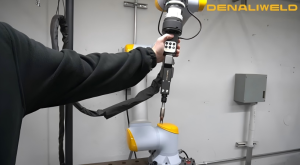
- Teaching simple path points (physically showing the robot where to go)
These are the day-to-day skills most teams need before advanced programming ever becomes relevant. So, focus on teaching them these skills first. Cobot programming for welders can come later.
Quality Awareness and Process Discipline
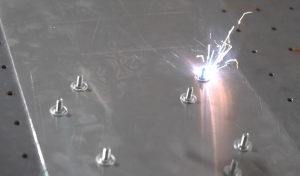
Throughout the cobot welding process, operators will need to conduct visual inspections, beat consistency checks, fixture verification, and thorough process documentation. These actions help ensure quality and consistency remain intact on the job.
A disciplined operator will result in lower scrap, fewer reworks, and faster training progress for the team.
How Is Cobot Welding Training Different from Traditional Welder Training?
Production managers often ask the questions: How hard is it to train a team for cobot welding? How is cobot training different from manual welding training?
In a nutshell, manual welding training depends on traditional skill-heavy hand control actions, such as precise torch angle control, travel speed, and hand stability. Meanwhile, cobot training depends more on setup accuracy, repeatable workflows, and process validation.
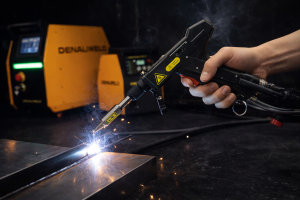
Many teams can learn cobot operation faster than high-skill manual processes, but still need structured onboarding. One example of a cobot system that is easy to learn is the Denaliweld Cobot Series.
Less Manual Dexterity, More Process Control
Cobot welding reduces some of the physical consistency demands placed on manual welders. When you have robots handling these physical tasks regularly, an operator can focus more of their attention on setup, path confirmation, and result monitoring.
Why Training Can Be Faster Than Expected
Cobot welding training is often accelerated because cobot systems are user-friendly and reduce the common barrier to entry for operators, as often seen with traditional welding. The modern, more intuitive interfaces and guided workflows associated with cobot welding can shorten ramp-up time for teams that are new to automation.
Where Manual Experience Still Matters Most
Of course, it is still critical to understand the situations where experienced welders still provide critical value with their manual experience and skill. These situations include:
- Part variation
- Weld quality judgment
- Process correction
Cobots are designed to complement skilled workers, but they are not meant to replace their knowledge of the entire welding process.
What Safety Training Is Required for Cobot Welding?
Collaborative robots may be easier to work around than traditional industrial robots, but they still require clear safety procedures. Comprehensive collaborative robot welding team training should include the following topics:
- Shared workspace awareness
- Emergency stops
- Startup and shutdown routines
- PPE, laser, and arc safety requirements (depending on the system and safe recovery from faults)
Teams should be trained not just to operate the equipment, but to recognize any unsafe conditions that might exist before they cause any production problems. Learn more about collaborative robot welding safety and use cases for more information.
Shared Workspace and Safe Interaction Rules
Operators must be thoroughly trained on safe positioning, reach zones, collision awareness, and handoff procedures between people and the machinery. Teams need consistent rules even in collaborative environments to ensure they stay safe whenever they interact with machinery.
Startup, Shutdown, and Emergency Response
Essential safety training must include lockout considerations, emergency stops, fault handling, restart procedures, and who is authorized to intervene when a machine stops unexpectedly. Teach the team that repeatable safety routines can reduce production downtime as well as risk to the operators.
PPE, Supervision, and Safety Culture
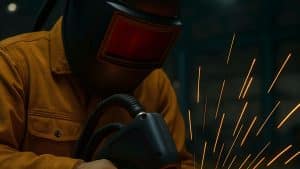
Make sure your team understands that PPE (personal protective equipment) is essential to wear to protect operators from UV light, fumes, and heat. Supervisor oversight and refresher training will help ensure that operators follow safety procedures and guidelines to maintain a good safety culture in the workplace. The result of which will include smoother cobot adoption and stronger operator confidence on the job.
Do Welders Need to Learn Robot Programming?
Most cobot welding teams do not need deep robotics expertise for everyday production tasks. There is a distinct difference between operator-level programming and engineer-level programming. Operators only need to learn the much simpler operator-level programming skills, such as:
- Loading saved programs
- Adjusting basic path points
- Changing recipes or job parameters
- Verifying repeatability after setup changes
These are not advanced programming skills. They are skills that almost any welder can pick up fairly quickly. For more detailed steps, review the cobot programming and navigational guide.
The Programming Skills Most Operators Actually Use
The only programming skills that operators will need to learn and use include:
- Simple teaching
- Jog controls
- Waypoint edits
- Recipe selection
For instance, waypoint editing is the process of adjusting and updating the specific positions along a welding path in which a cobot has been taught to follow. Most training should stay close to daily production use rather than engaging in more theoretical programming or coding.
When You Need a Specialist or Integrator
When advanced cobot welding troubleshooting, logic changes, sensor integration, or complex cell updates become too complicated or time-consuming to figure out on their own, teams should escalate the matter to a specialist or integrator for further review. Operators should not overload themselves with complex engineering tasks if they cannot figure out the problem quickly.
How to Keep Programming Training Practical
The best ways to keep programming training practical for operators is to train according to job family, part type, or task frequency rather than by abstract robotics lessons. Programming should be seen as a helpful production tool for everyday operations rather than a specialized technical status badge.
What Mistakes Should Teams Avoid When Adopting Cobot Welding?
Some of the most common mistakes and rollout problems associated with cobot welding adoption in a fabrication shop include:
- Expecting instant productivity
- Training only one person
- Ignoring fixture quality
- Underestimating part consistency
- Failing to define inspection standards
To ensure teams avoid these mistakes, cobot training should be phased in and remain role-based rather than rushed. Most teams benefit from an onboarding timeline that starts with safe operation and basic tasks. After they learn these skills, you can expand their lessons into setup, quality, and troubleshooting responsibilities.
Skipping Fixturing and Part Preparation
A well-programmed cobot cannot fix inconsistent parts, poor fit-up, or unstable fixtures. If a part varies significantly and the robot is programmed to follow a fixed path, the weld will ultimately fail. That is why preparation discipline is a key part of training success. It will help operators prepare the right parts for the job.
Treating Training as a One-Day Event
Real adoption requires staged practice, supervised production runs, and repeat exposure. Operators often forget these things if they treat their training as some one-day event rather than a long-lasting strategy. The only way they will continue to remember is if they are constantly exposed to machine use each day. Repetition is what ultimately gives operators more confidence in cobot welding under real shop conditions.
Measuring Success the Wrong Way
You should not judge the rollout only by the cycle time during the first week because it might be slower as the team learns the process. Therefore, some of the better early metrics to measure a team’s success include safety compliance, repeatability, defect rate and operator independence.
Building a Practical Cobot Welding Training Plan
Managers should separate their lessons into clear phases when building a training plan. These phases should cover the following lessons:
- Operator basics
- Safe production use
- Setup and changeover
- Quality checks
- Basic troubleshooting
Each phase covers a critical aspect of cobot welding operations. Team leaders should assign ownership across operators, supervisors, and technical support rather than expecting one person to master everything. If each team member can master one of these areas, the entire team can work together to ensure a successful cobot welding job.
Phase 1: Core Operator Readiness
Is the operator truly ready? They will be once they become familiar with the machines and learn about safety procedures, part loading, recipe selection, and normal startup and shutdown routines.
Phase 2: Supervised Production and Quality Control
Teams should move into guided or supervised production while learning about inspection standards and repeatable process checks. This will help enforce quality control on their work as they learn the process.
Phase 3: Cross-Training and Continuous Improvement
Operators and teams must continuously improve their knowledge and skills, especially as procedures update and production expands. To assist in this effort, more emphasis should be placed on training backups, documenting best practices, and sharing operational procedure updates.
Conclusion
Successful cobot welding training is built on highly practical, role-specific skills rather than advanced robotics theory. Operators must learn the importance of safety, setup accuracy, basic programming, quality awareness, and troubleshooting discipline. Managers should treat cobot adoption into a fabrication shop as a team capability-building process, not just another equipment purchase.
Are you ready to transform your fabrication shop floor with reliable cobot welding automation? Explore Denaliweld cobot solutions and training friendly-systems.
FAQ
What skills do operators actually need for cobot welding?
Operators need to possess general welding knowledge and the skills needed to initiate a safe and effective cobot welding operation. They don’t need to become robotics engineers. They just need to have a basic understanding of cobot welding.
How hard is it to train a team for cobot welding?
It is not too difficult. In fact, cobot welding training is often a faster process than traditional manual welding training. The lessons shift away from the manual hand precision aspect of the job and focuses more on the setup, accuracy, workflows, and process control.
Do welders need to learn robot programming?
No, welders are not required to learn robot programming or become robotics engineers. Operators only need to understand the functional, daily tasks associated with cobot welding operations.
What safety training is required for cobot welding?
Safety training for cobot welding should cover shared workspace awareness, PPE use, startup & shutdown routines, and emergency stop procedures.