

Industrial laser welders used in high-volume production must do more than create clean welds. They need to support long shifts, stable output, and safety-controlled work areas. Explore industrial laser welders built for nonstop operation, speed, and reliability. The right system is not always the highest-powered model. It is the machine that matches workload, material mix, duty cycle, and risk.
Industrial Laser Welders vs. Standard Systems: What Changes in High-Volume Production?
Industrial laser welders differ from standard systems because they are selected around repeated production demand. A standard unit may work for lighter fabrication or lower-volume jobs. In high-volume environments, the question changes from “Can it weld this part?” to “Can it keep welding this part across repeated shifts?”
Factor | Standard laser welder | Industrial laser welder |
Duty cycle | Better for intermittent work | Built around longer operating windows |
Cooling stability | Less critical in short runs | Central to repeatable production |
Safety planning | Often workstation-level | Usually work-cell-level |
Throughput | Job-by-job output | Sustained output and scheduling confidence |
Maintenance | Reactive or periodic | Planned around uptime targets |
Buyers should judge systems by duty cycle, thermal control, operator protection, workflow fit, and maintenance access. Power matters, but wattage alone does not define the best machine.
Criteria Buyers Should Use Instead of Generic “Best” Claims
The best industrial machine is the one that fits the operation. A shop running short batches has different needs from a plant running long shifts. Strong buying criteria include continuous-duty capability, repeatable weld quality, cooling stability, operator safeguards, manageable upkeep, and compatibility with automation or cobot-assisted workflows. These factors matter more than broad claims because downtime and rework cost more in high-output settings.
Which Industrial Laser Welders Are Best for Heavy-Duty Work and 24/7 Operation?
The best industrial laser welders for heavy-duty work are systems built for continuous operation, stable thermal performance, and repeatable output. For 24/7 operation, the unit must hold weld quality over long runs without heat-related instability, excessive stoppages, or constant operator correction.
Denaliweld’s Air Cooled 2Kw Laser Welding Machine fits continuous-duty industrial use where teams want an air-cooled system with easier deployment and lower system complexity. Denaliweld’s product page lists a 100% duty cycle for continuous operation and welding up to 1/4 inch stainless steel and aluminum.
For heavier-output applications, the Air Cooled 3Kw Laser Welding Machine is stronger. Its product page lists welding capability up to 3/8 inch stainless steel and aluminum. That makes it a better match when throughput, material thickness, or shift intensity is higher.
Pros of air-cooled industrial systems: easier setup, fewer cooling-system concerns, strong mobility, and practical production fit.
Cons to plan for: operators still need training, safety controls, preventive maintenance, and a workload-matched system.
Which Industrial Laser Welders Have Advanced Safety Features?
Industrial laser welders with advanced safety features are supported by both machine-level controls and work-cell protection. Safety is not only a product feature. It is a system of shielding, procedures, PPE, access control, signage, and operator discipline.
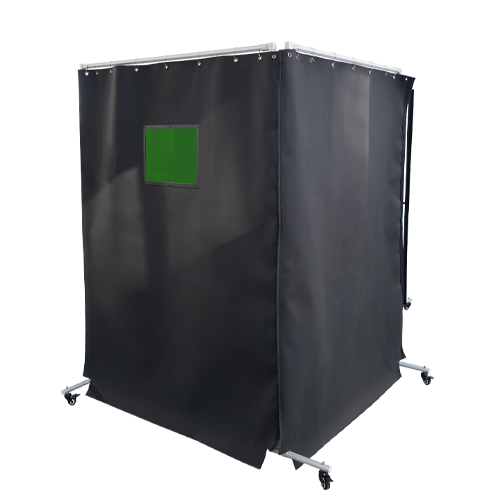
Denaliweld laser welders include safety-oriented controls such as safety settings, monitoring, and emergency-stop features. For the surrounding work area, the Denaliweld Laser Safety Curtain helps define protected welding zones. Its page describes OD-rated optical protection, fire-retardant and heat-resistant construction, modular connection, and use in Class 4 laser processing environments.
OSHA’s laser hazards guidance treats laser safety as an operational issue involving training, hazard control, fire safety, and emergency response.
Which Industrial Laser Welders Offer the Fastest Processing Speeds?
The fastest industrial laser welders are not automatically the highest-powered models. Real processing speed depends on material type, material thickness, fit-up quality, weld path, heat control, and operator consistency.
In production, the better benchmark is repeatable throughput. A faster pass has limited value if it creates rework, distortion, missed seams, or unstable welds. For lighter workloads, the Denaliweld Air Cooled 2Kw system may offer the right balance of speed, portability, and usability. For higher-output applications, the Air Cooled 3Kw system is the better fit because it is designed for thicker material capacity and heavier production demand.
Speed should always be judged with quality. The fastest useful system completes more acceptable welds per shift.
What Are the Most Reliable Industrial Laser Welders?
The most reliable industrial laser welders deliver stable output, predictable maintenance, and consistent weld quality over long production runs. Reliability depends on machine design, cooling stability, environment, operator training, and process discipline.
Denaliweld’s air-cooled systems are useful examples because they combine continuous-operation positioning with modular design, data tracking, and practical maintenance access. Those traits support uptime planning. Still, no machine is reliable in every setting. A system can perform well in one plant and miss expectations in another if material thickness, shift length, safety planning, or training are mismatched.
For value, buyers should look beyond purchase price. A lower-cost setup can become expensive if it causes rework, stoppages, or safety retrofits. A properly matched industrial laser welder can create value through higher uptime, steadier scheduling, and fewer avoidable interruptions.
How to Match Industrial Laser Welding Systems to Production Demand
Choosing the right system starts with production reality. Match the welder to material type, thickness, volume, shift length, safety needs, and downtime tolerance.
Decision flow:
Production volume → material and thickness → shift length → required throughput → safety cell design → maintenance plan → system choice
For lighter industrial workloads, choose the Denaliweld Air Cooled 2Kw Laser Welding Machine. For heavier-duty output, thicker material, or higher shift intensity, choose the Air Cooled 3Kw Laser Welding Machine. For safer work-cell planning, add laser safety curtains early instead of treating barriers as an afterthought.
Backup options: standard systems may suit intermittent work. Industrial air-cooled systems suit continuous use. The 3Kw option suits higher-output demand.
FAQ
Which industrial laser welders are best for round-the-clock production?
Systems with continuous-duty capability, stable cooling, reliable controls, and planned maintenance support are best.
What safety systems should come with an industrial laser welding setup?
Use machine safety controls, PPE, guarded work zones, beam containment, warning signs, training, and laser safety curtains.
How do industrial laser welders differ from standard shop models?
Industrial systems are better matched to longer shifts, higher utilization, safety-controlled work cells, and repeatable output.
Does faster laser welding always mean better production output?
No. Speed only helps when weld quality, fit-up, heat control, and downtime remain controlled.
What makes an industrial laser welder reliable over long production runs?
Reliability comes from proper workload fit, stable cooling, trained operators, maintenance discipline, and repeatable weld settings.
When should a manufacturer choose a higher-output industrial laser welder?
Choose one when material thickness, throughput goals, or shift intensity exceed a lighter-duty setup.
Conclusion
The best industrial laser welding systems for high-volume production match real duty cycle, safety requirements, speed goals, and reliability expectations. Standard systems can serve lighter work, but industrial environments need stronger planning around uptime, operator protection, and process discipline. To evaluate an industrial-ready setup, review Denaliweld’s air-cooled laser welding systems and laser safety curtains, then match the equipment to your production demand before scaling.