

Introduction
The cost of a laser welding machine depends on more than its initial price. Search for laser welding machine prices online, and you are likely to find a wide range of figures because the purchase price is only one part of the overall cost.
Buyers who focus on the purchase price alone may overlook the expenses that continue after installation, including electricity, consumables, maintenance, and labor. These costs are especially important for factory procurement teams and shop owners planning to operate the machine for years rather than for a single project. Instead of relying on broad price estimates, this article explains the main factors behind the purchase price, day-to-day operating expenses, and potential labor savings from automation. This helps buyers compare machines based on total cost of ownership rather than upfront cost alone.
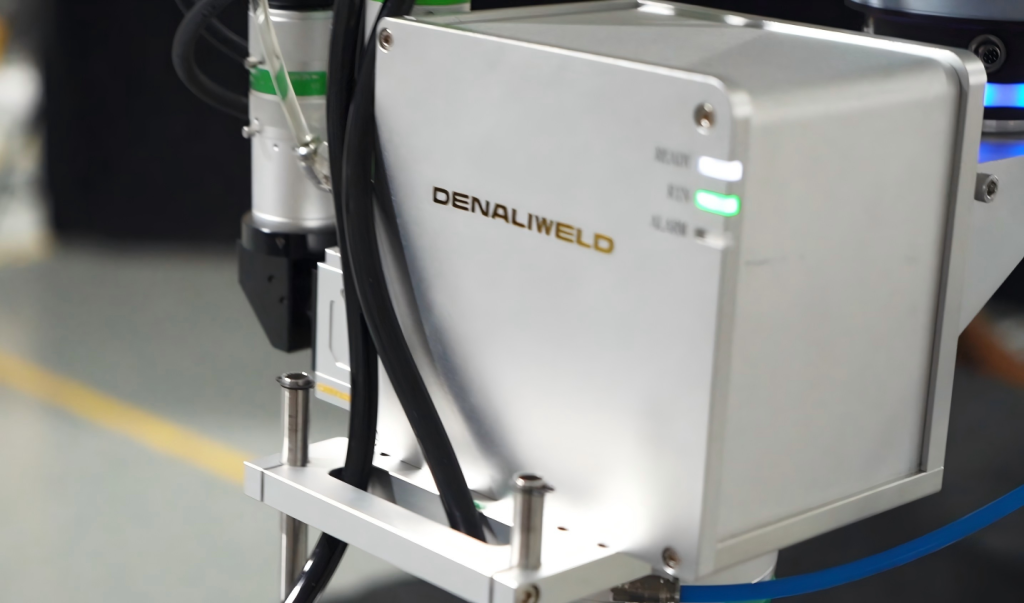
What factors affect the price of a laser welding machine?
Several factors determine where a laser welding machine falls within the price range, and laser power is one of the most important. Moving from a lower wattage tier to a higher one, such as from a 1500W unit to a 3000W unit, usually requires heavier internal components, a larger power supply, and a higher duty cycle rating, not simply a more powerful laser source. Cooling method also affects the price. Air-cooled machines generally have a lower upfront cost and a more compact design, while water-cooled systems involve greater complexity, higher continuous power capability, and additional chiller maintenance.
Portability, automation readiness, and optional functions can also increase the purchase price. A machine designed for automation integration, dual wire feeding, seam tracking, or built-in production data monitoring requires more engineering than a basic welding system. These features may not directly increase laser power, but they can improve process control, flexibility, and production efficiency.
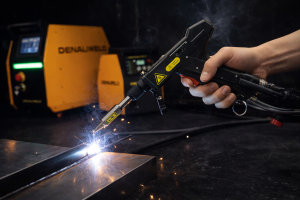
Denaliweld’s air-cooled laser welding machine line provides a useful example. The JET2000 and JET3000 share the same platform, but differences in wattage, power consumption, and duty cycle rating contribute to the difference in price.
The practical approach is to match the machine specifications to the materials and thicknesses welded most often. A shop welding 16-gauge sheet metal does not require the same system as one processing 3/8-inch stainless steel throughout the day. Purchasing more power than the application requires is a common way for procurement teams to overspend. Denaliweld’s welding parameters guide provides recommended settings by material and thickness, making it a useful starting point before comparing machines model by model.
Quick comparison: air-cooled vs. water-cooled
Factor | Air-Cooled | Water-Cooled |
Typical upfront cost | Lower | Higher |
Continuous power output | Moderate | Higher |
Maintenance | Simpler, no chiller | Includes chiller upkeep |
Footprint & portability | Smaller, more portable | Larger, less portable |
Best fit | Lighter-duty, mixed-material shops | High-volume, continuous-duty operations |
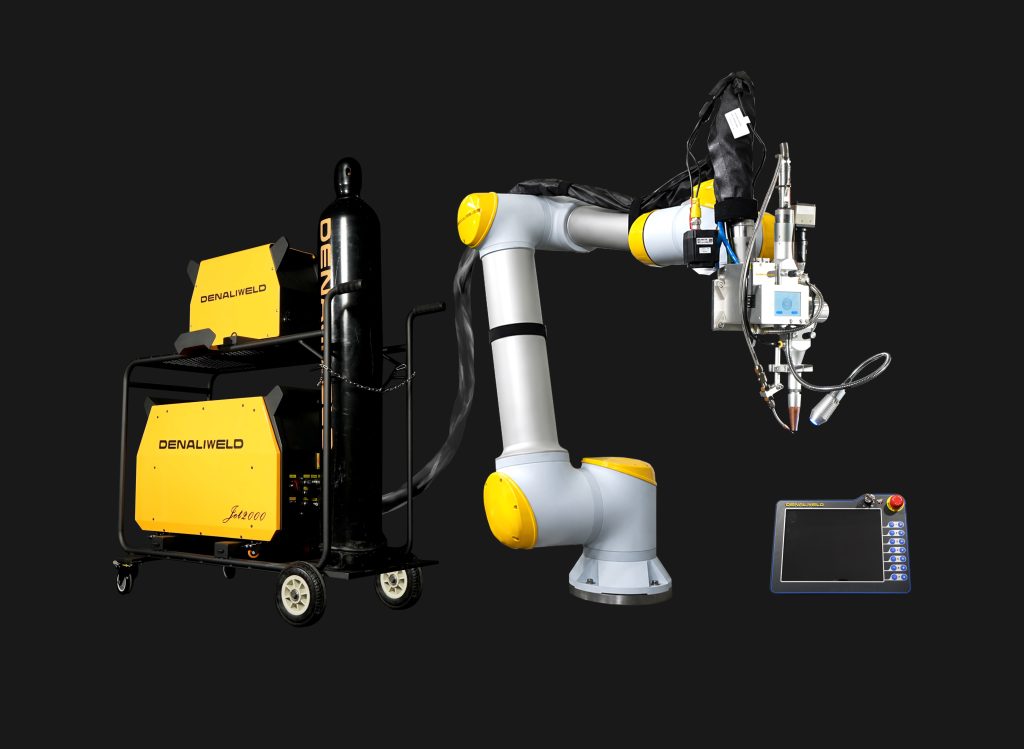
What determines the total cost of ownership for a laser welding machine?
Total cost of ownership includes all costs associated with a machine over its service life. This covers the initial purchase price, operating expenses such as electricity, consumables, and maintenance, as well as labor costs, while also accounting for productivity improvements. The table below summarizes the main cost drivers.
What drives each part of total cost of ownership
Cost component | What drives it |
Purchase price | Power tier, cooling method, automation features |
Electricity | Power consumption (kW) × hours run × local industrial rate (~8.58¢/kWh U.S. average, EIA, March 2026) |
Consumables | Welding wire, shielding gas, lens and optic cleaning |
Maintenance | Cooling system complexity; water-cooled adds chiller upkeep |
Labor | Manual hours per part vs. automated or cobot-assisted welding |
Resale value & lifespan | Build quality and duty cycle rating over time |
Electricity is one of the easiest operating costs to calculate, although it is often overlooked. According to the U.S. Energy Information Administration, the average industrial electricity rate in the United States was 8.58 cents per kilowatt-hour in March 2026. Multiplying the machine’s rated power consumption by its operating hours and the local industrial electricity rate provides an estimate of daily electricity cost. A machine rated at approximately 7.7 kW will use more electricity over an eight-hour shift than one rated closer to 6.5 kW, even if both can perform the same task.
Duty cycle rating also affects long-term cost. A machine rated for 100 percent duty cycle can operate continuously under its specified operating conditions without the interruptions or thermal limitations associated with lower-rated equipment. These interruptions can reduce output and increase production cost. Resale value and expected lifespan should also be considered, since two machines with the same purchase price may deliver very different long-term value if one remains reliable and retains its value for longer.
How automation reduces long-term operating costs
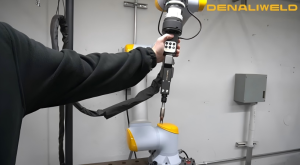
Labor is often one of the largest recurring costs in a welding operation, which makes automation-ready features an important part of the total cost calculation. Moving repetitive work from fully manual welding to a cobot welding system can reduce the operator time required per part and improve process consistency. Over time, this may also lower the costs associated with rework, scrap, and repeated production steps.
Although automation requires a higher initial investment, the return typically comes from reduced labor hours and more consistent output rather than a lower machine purchase price. For shops with sufficient production volume, a ful lrobotic laser welding system may provide greater labor savings than a cobot setup, although it generally requires more extensive fixturing, programming, and implementation planning.
Tax treatment may also affect the timing of the investment cost. Under IRS Section 179, businesses may elect to deduct some or all of the cost of qualifying equipment in the year it is placed in service rather than recovering the cost entirely through depreciation over several years. For tax years beginning in 2025, the maximum Section 179 deduction is $2,500,000, subject to applicable purchase thresholds, taxable income limits, and eligibility requirements. Businesses should confirm how these rules apply to their specific circumstances with a qualified tax professional.
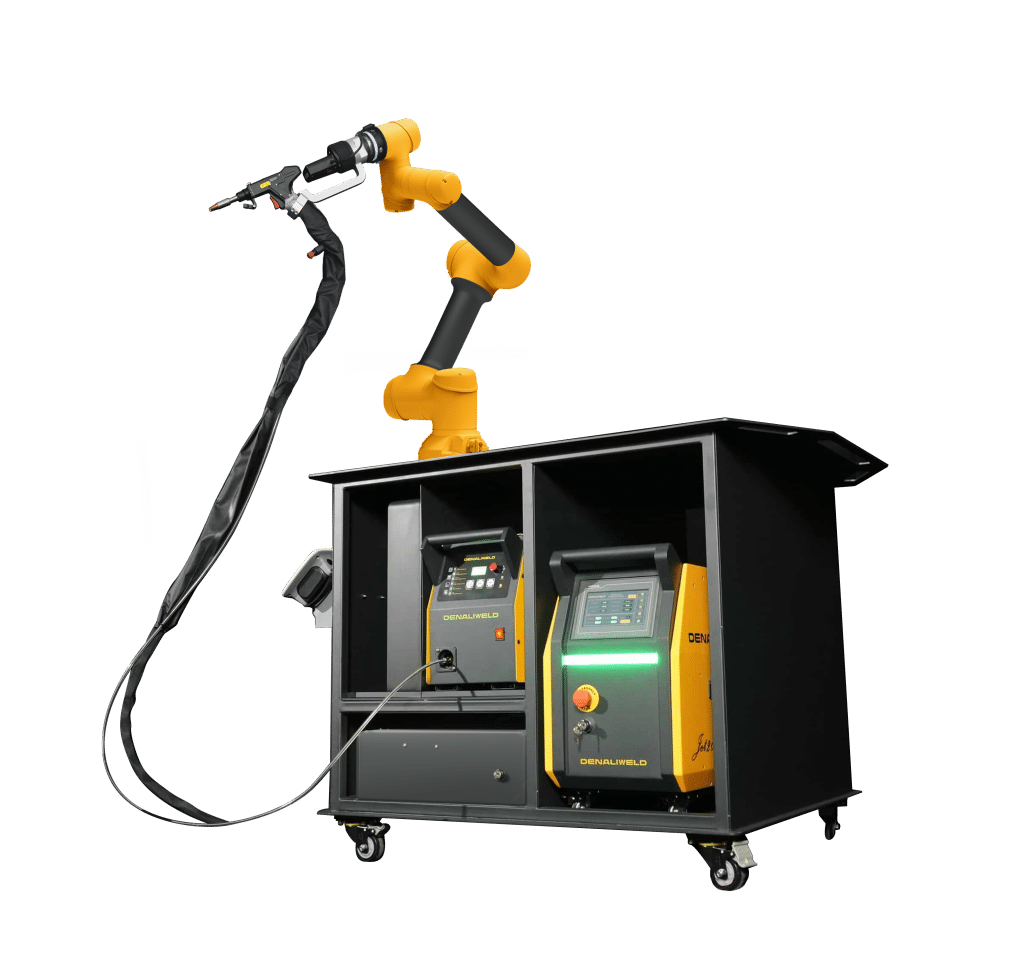
How to choose a laser welding machine with the lowest long-term cost
A focused shortlist makes it easier to compare machines based on actual production requirements.
- Match the power tier to the materials and thicknesses welded most often.
- Compare duty cycle ratings across the shortlisted models.
- Consider whether the team has the capacity to maintain an air-cooled or water-cooled system.
- Account for automation readiness if production volume may increase over the next few years.
- Ask suppliers about consumable costs, maintenance requirements, and after-sales service and support.
Once the operating requirements are clear, buyers should request a detailed quote based on their application. They can review Denaliweld’s laser welding machines to compare the specifications of available models and identify the systems that best match their production needs, or contact the team directly for a quote.
The final decision should be based on total cost of ownership rather than upfront purchase price alone.
FAQs
What factors affect the price of a laser welding machine?
Laser power, cooling method, portability, and automation readiness are among the main factors. Higher-wattage machines and water-cooled systems generally cost more upfront because they require more robust components and cooling infrastructure. Features such as seam tracking, dual wire feeding, and built-in production data monitoring can also increase design and manufacturing complexity.
What is included in the total cost of ownership of a laser welding machine?
Total cost of ownership includes the purchase price and ongoing expenses such as electricity, welding wire, shielding gas, routine maintenance, and labor. It should also account for productivity gains, duty cycle rating, expected service life, and potential resale value.
How can businesses reduce the operating cost of a laser welding machine?
Automation-ready features and cobot integration can reduce operator time and improve process consistency, which may lower rework and scrap costs. Businesses can also control costs by matching the machine’s power and specifications to the materials, thicknesses, and production volumes they handle most often.