

Introduction
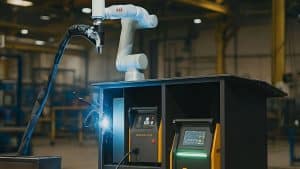
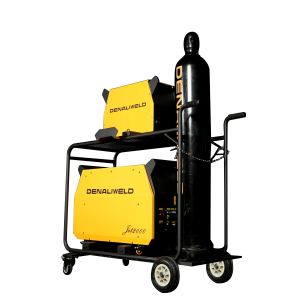
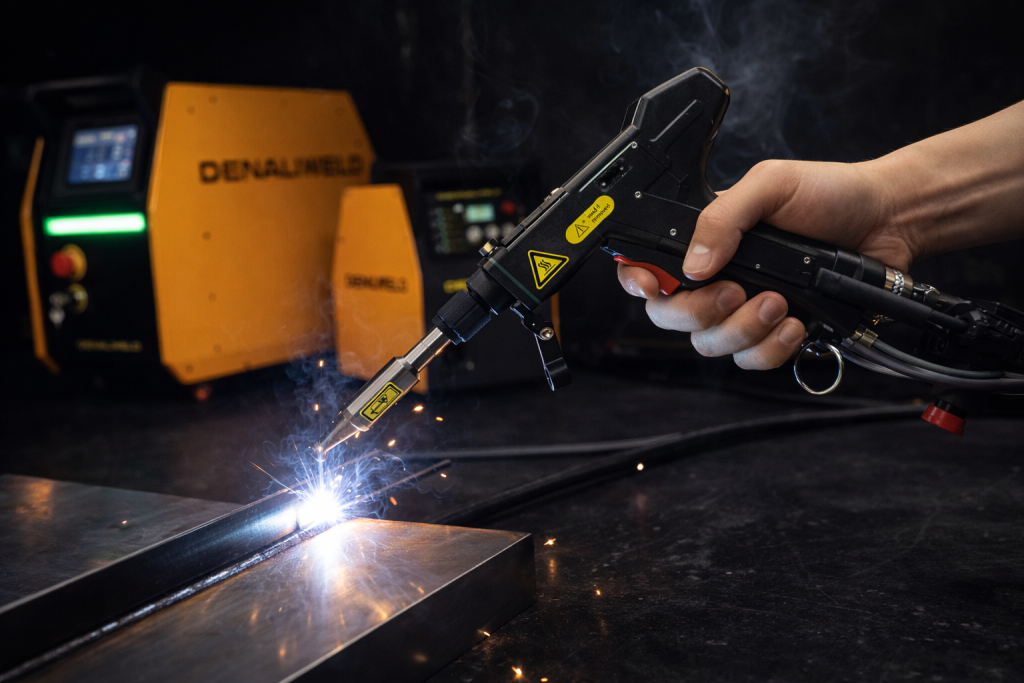
A cobot welding system is only as consistent as the source behind it. The arm handles motion with repeatability measured in hundredths of a millimeter, but the fiber laser welder controls penetration, heat input, and fusion. When the source drifts, a perfect path still produces uneven welds, and the operator spends a week chasing a motion problem that was never a motion problem. This article covers what makes fiber laser welders suited to cobot integration, how source stability shows up in automated weld quality, and what to verify before pairing a laser with a cobot platform. Denaliweld’s JET 3000 air-cooled fiber laser welder includes a ROBOX interface for switching between handheld, cobot, and robot operation.
What Makes a Fiber Laser Welder Suited to Cobot Welding
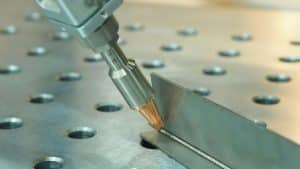
A fiber laser generates its beam inside an optical fiber doped with rare-earth elements, and ytterbium-doped sources land at roughly 1060 to 1100 nm. Metals absorb that band well, which is why fiber replaced older technologies across most industrial welding work. The Denaliweld JET 3000 operates in exactly that range.
For cobot work, how the beam gets delivered matters as much as its wavelength. A fiber laser welder sends the beam through a flexible cable that routes alongside the cobot’s own harness. CO₂ systems need articulated mirror arms; Nd:YAG systems add bulk and cooling load. Neither travels well on a collaborative arm designed around a modest payload. The JET 3000 uses roughly a 10 m delivery fiber and a welding head weighing about 900 g, which leaves real headroom on a 5 or 10 kg payload cobot once fixtured tooling and cable are accounted for.
Beam quality and focus stability decide whether part 1000 matches part 1. A fiber source holds a small, consistent spot across long runs. The JET 3000 uses a fixed 150 mm focal length, so the working distance the cobot was programmed against does not shift halfway through a shift.
Power stability is where the difference becomes measurable. A three-second seam leaves no room to recover from an output dip, and the result is a cold joint or a blow-through depending on which way the source drifts. Denaliweld’s patented CUAL mosaic laser source is rated for continuous operation from -10 °C to 40 °C, and the in-house control system shapes a smooth output curve rather than letting power step between levels. The 976 nm pump reaches around 45 percent power transfer efficiency against under 20 percent for traditional 915 nm pumps, which is part of why a 3 kW machine draws 9.2 kW rather than considerably more.

Integration Challenges When Pairing a Fiber Laser Welder with a Cobot
Integration is not bolting a welding head to the end of an arm. The source, cooling, wire feeder, gas delivery, and control software all have to agree with the cobot controller before the cell produces a usable part.
Cooling is the first practical constraint. A water-cooled industrial fiber laser welder brings a chiller, hoses, and a fixed location with it. An air-cooled machine removes all of that. The JET 3000 weighs about 90 lb and cools without a chiller, so the cell can move between stations without replumbing anything.
The end effector carries more than the laser head. Shielding gas lines and optional filler wire ride along with it, and cable management stops being cosmetic once the arm starts cycling. A tangled harness interrupts an automated run in a way it never does during handheld work. Denaliweld’s wire feeder supports single or double motor push-pull feeding up to 2 mm wire, which covers most cobot filler applications without an external unit.
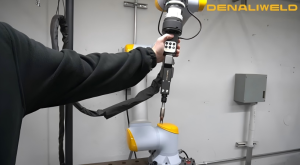
Control architecture is the part buyers underestimate. A loosely coupled cell runs the cobot’s motion program and the laser’s weld recipe as two separate things and hopes they stay in step. Unified control ties power, speed, and beam modulation to the cobot path. Denaliweld’s ROBOX system allows one-click switching between handheld, cobot, and full robot operation on the same source, so a shop can weld manually this year and automate the same jobs next year without replacing core hardware.
Safety planning does not get easier because a robot is holding the head. AWS treats high-power laser welding as Class 4 work requiring a laser controlled area, an interlocked access door, a key switch, and an emergency stop that terminates emission immediately. An automated cell needs every one of those, plus a defined response for someone walking in mid-cycle.

How Source Quality Affects Automated Weld Results
Cobots are excellent at repeatability and useless at compensation. The arm will hit the same coordinates on part 1000 that it hit on part 1. If the source changed its spot size, power density, or focal position in between, the arm has no way to know and no way to correct.
Focus stability is the clearest example. A fixed 150 mm focal length with stable optics gives the same penetration across a run. Thermal drift in the resonator or the delivery fiber produces variation the cobot cannot see, and it surfaces as inconsistent penetration on parts that were programmed identically.
Beam modulation matters as soon as the application varies. Some cobot seams want continuous wave. Others benefit from modulated output or an oscillation pattern that widens the bead and bridges a gap the fixturing could not close. The JET 3000 supports continuous and modulated operating modes with spot and line oscillation built in, which avoids bolting on external hardware to get a wider bead.
Data acquisition turns a suspicion into a diagnosis. Recording power, speed, and weld time per cycle lets an engineer correlate source behavior against the parts that failed inspection instead of guessing. Denaliweld’s welding log system stores that data for monitoring and cost calculation.
Whichever source reaches the shortlist, demo it on your own parts and measure repeatability across a production run. A single test coupon only proves the machine can make one good weld.
Choosing Between Handheld and Cobot-Ready Fiber Laser Welders
Not every fiber laser welder machine is built for automation. Some are handheld-only, with control interfaces designed around trigger safety and operator ergonomics. Others carry an automation interface from the start.
The dual-mode case is straightforward. A shop that buys a handheld fiber laser welder to learn the process and later wants to automate the same jobs either replaces the source or does not. A cobot-ready machine with manual and automatic switching protects the first purchase.
Factor | Handheld fiber laser welder | Cobot-ready fiber laser welder |
Control priority | Trigger safety, grip ergonomics | Recipe storage, remote start and stop |
Interface | Operator panel and physical controls | EtherCAT, Modbus, digital I/O |
Best fit | Repair, short runs, varied locations | Repeatable production, bottleneck parts |
Upgrade path | Source replacement to automate | Same source serves both modes |
Before buying, verify three things: a documented automation interface, proven cobot compatibility rather than a marketing claim, and field support for integrated setups. A supplier that has only ever commissioned handheld units will be learning on your project.
Conclusion
A cobot welding cell depends on the fiber laser welder behind it for consistent penetration, clean fusion, and repeatable output. Fiber sources suit cobot integration because the beam travels through a flexible cable, the spot stays stable across long runs, and the hardware is compact enough to sit beside an arm without a chiller. None of that helps if the control architecture and cooling design do not match the workflow the cell is meant to run. Shops evaluating automated welding sources can review Denaliweld’s fiber laser welding range and the air-cooled 3 kW JET 3000 as a starting reference.