

Introduction
The choice between a handheld laser welder and an automated welding system is often described as a technology upgrade. On a production floor, it is more accurately a question of part mix. A handheld system puts travel speed, angle, and access in the operator’s hands, which is valuable when every job is different. Automation puts those variables into programmed motion, which becomes valuable when the same part returns often enough to justify programming and fixturing. The useful comparison is therefore not manual versus advanced. It is flexibility versus repeatability, measured against run length, joint access, labor dependency, and available floor space. DenaliWeld supports both operating models, including equipment that can move from manual work into robot or cobot use.
How the two approaches differ in practice
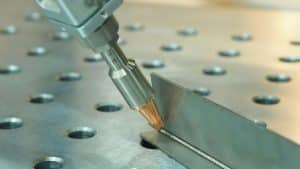
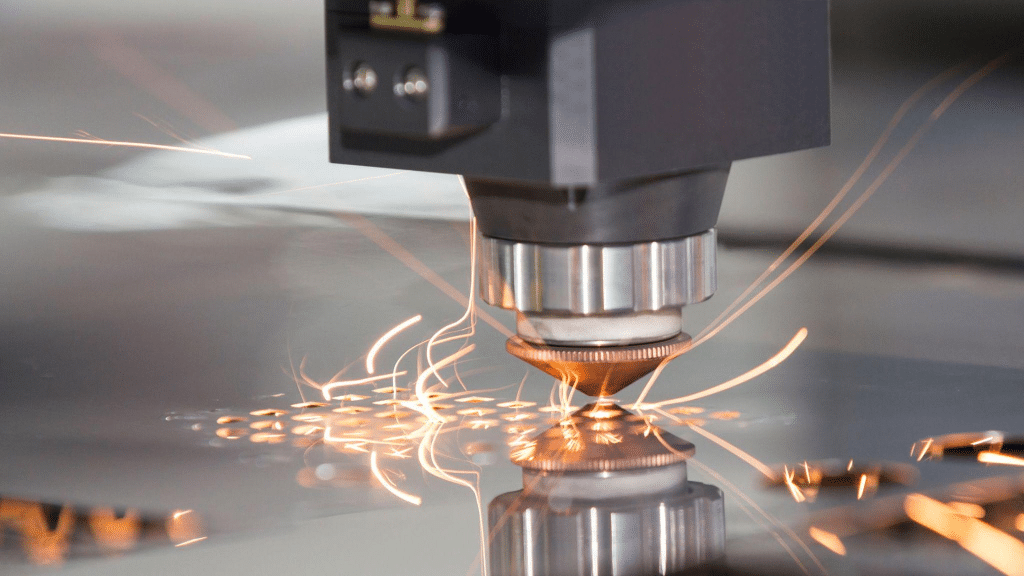
In many installations, both approaches use the same class of fiber laser source. The difference is what controls beam position, torch angle, travel speed, and standoff. With handheld welding, the operator makes continuous corrections as the joint changes. That makes the process tolerant of real shop conditions: a repaired edge that is not perfectly straight, an assembly that cannot be repositioned, or a one-off bracket that will never be seen again. The tradeoff is that output follows operator technique, fatigue, and consistency from shift to shift.
An automated laser welder reverses that relationship. Motion is taught or programmed, then repeated. Once the part is located correctly, the system can hold a constant speed and trajectory over long seams without the natural variation of hand motion. But the robot cannot make a poorly presented joint disappear. Fixture accuracy, loading repeatability, cable routing, focal position, and process settings still determine the result.
Setup time also moves to a different place. Handheld work can start within minutes, but positioning and handling are repeated for each part. An automated cell may require hours or days of fixturing, programming, safety validation, and first-article work, then very little setup per unit. That is why the crossover is driven by recurring volume rather than a universal batch-size rule. A short program and simple fixture may pay back quickly; a complex fixture for a part that changes next month may never do so.
Where handheld laser welders fit best
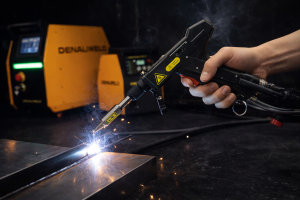
Handheld laser welding is strongest where the work changes faster than a program can be justified. Job shops with one-offs, prototypes, short runs, and a broad customer mix often benefit because the operator can move directly from drawing to part without building a dedicated cell. Repair and rework are another clear fit. Cracked brackets, worn edges, damaged fabrications, and installed assemblies often cannot be brought to a fixed station at all.
Access matters as much as volume. Large frames, enclosures, tanks, and assemblies with joints on several sides are easier to approach with a portable laser welder than with fixed automation. DenaliWeld’s Air-Cooled Laser Welding Machine is designed around that mobility: the current JET Series is listed at 90 lb, uses air cooling rather than a separate chiller, and is automation-ready through the ROBOX interface. That gives a shop a practical manual platform without closing off a later automation path.
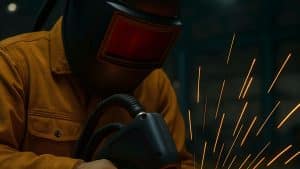
The limitation is process dependence on the person holding the head. Consistency across operators requires documented parameters, stable fit-up, training, and routine checks. Long shifts can also introduce changes in travel speed or torch position. Safety is not reduced because the machine is handheld. High-power handheld laser welding is Class 4 work; AWS guidance on handheld laser welding safety calls for a defined laser-controlled area, suitable wavelength-rated eye and face protection, and formal operating procedures. The operator is inside the hazard zone, so work-area controls are as important as personal protective equipment.

Where automated welding systems deliver more
Automation becomes easier to defend when a shop can point to a repeat part, a long seam, or a specific bottleneck. Once programming and fixturing are established, the cell can repeat the same path at controlled speed without changing technique between operators. That is useful for components subject to inspection, documented procedures, customer audits, or production records where variation must be kept within a known process window.
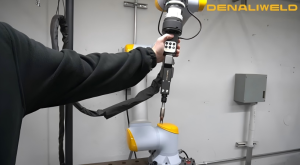
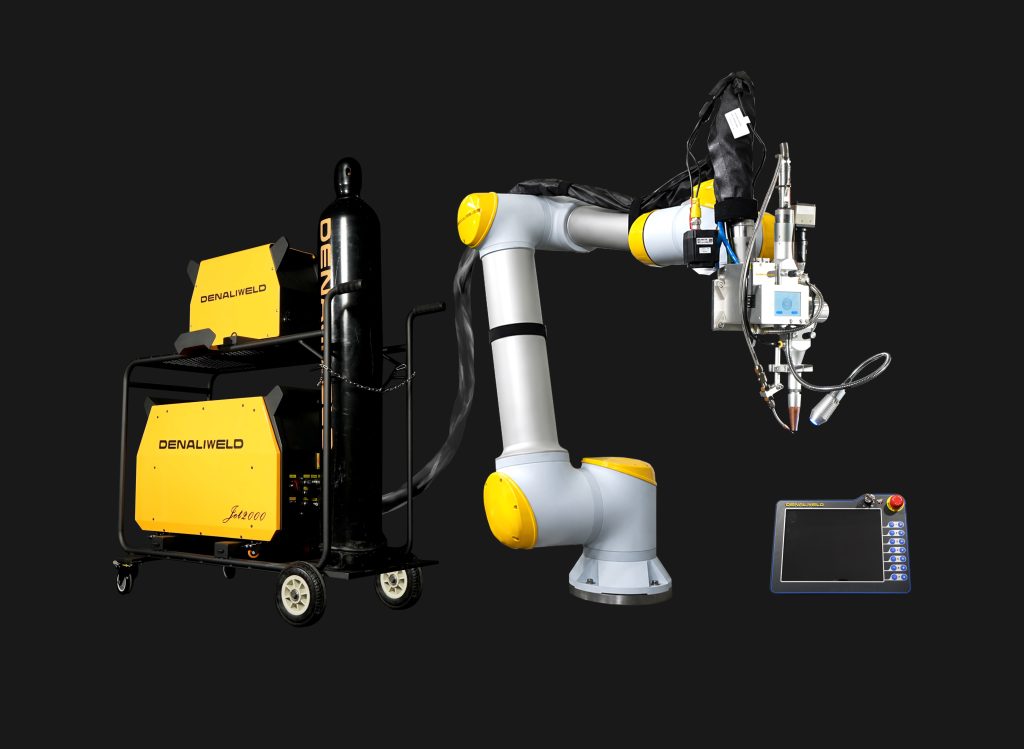
The strongest projects normally automate a defined problem rather than the entire welding department. A cobot cell can suit low-to-medium volume work that changes frequently and needs faster changeover. A full robotic system is better suited to higher recurring volume, larger working envelopes, and applications that justify more dedicated fixtures. Galvo or gantry arrangements can be effective for smaller repeated features where high-speed beam positioning matters more than flexible arm access. DenaliWeld’s COBOT Laser Welding System combines preset controls, welding data acquisition, optional seam tracking, and ROBOX switching between cobot and robot automation. Its robotic platform extends the same approach to more dedicated automated cells.
Automation also changes the labor requirement rather than simply removing it. Skilled welders still define fit-up standards, validate first articles, troubleshoot process drift, and handle the joints that need judgment. The robot takes the repetitive motion. Laser safety remains an engineered cell requirement: OSHA laser-hazard guidance emphasizes controlled areas, access controls, beam containment, and a formal hazard assessment for high-power laser systems. A collaborative arm does not make an open laser beam collaborative.
Handheld laser welder vs automated welding: practical comparison
Factor | Handheld laser welder | Automated welding system |
Setup pattern | Minutes to begin, repeated handling each part | Programming and fixturing up front, then minimal per unit |
Best-fit volume | Low volume, high mix, repair and one-off work | Repeat production or a clearly identified bottleneck |
Consistency | Tracks operator technique and fatigue | Repeatable within fixture and process tolerance |
Fixturing | Light clamping is often sufficient | Central to path accuracy and repeatability |
Joint access | Strong for awkward, large, or installed work | Limited to what the cell and fixture can present |
Floor space | Workstation plus laser-controlled safety zone | Cell, fixtures, guarding, and controlled area |
Operator requirement | Trained welder at the machine | Programming, loading, verification, and process support |
Portability | Air-cooled units can move between stations | Normally a fixed installation |
Dual-mode systems and how to decide
Many fabrication businesses need both models. A shop may run custom repair work all week and still have one assembly that repeats hundreds of times. In that case, forcing every job into automation wastes setup time, while keeping the repeat job fully manual wastes cycle time. A dual-mode source lets the shop separate those workflows without replacing the core laser system.
DenaliWeld uses ROBOX as the switching interface between manual, cobot, and robot workflows on compatible equipment. The value is less about the button itself than the migration path: a shop can establish laser welding parameters manually, identify the jobs that truly repeat, and automate those jobs when the production case is clear. The Robotic Laser Welding System is the logical next step when dedicated automation is justified.
Before choosing, ask six production questions: How many of each part run per month? How often does the part design change? How long are the seams? Does output vary materially by operator? Is one part already a documented bottleneck? Is there room for the fixture and laser-controlled cell? Repeat volume concentrated in a small part family points toward automation. A part mix that turns over weekly usually keeps handheld welding in the stronger position.
Conclusion
Handheld and automated laser welding solve different production problems. Handheld systems are usually the better fit for varied work, repair, awkward access, and jobs that do not repeat long enough to recover programming time. Automated systems earn their place on repeat parts, long seams, documented consistency requirements, and defined bottlenecks. In both cases, the process is only as stable as its fundamentals: fixturing and part presentation govern automation, while operator training and documented parameters govern handheld work. For shops between the two, a dual-mode architecture provides a lower-risk route from flexible manual welding to targeted automation.