

Understand how different laser welding methods impact speed, accuracy, and applications. Laser welding uses a concentrated beam to fuse metal with focused heat, narrow welds, and controlled distortion. The right technique depends on the part, not only the machine. Thin sheets, thick joints, tight tolerances, and high-volume production all call for different settings and setups.
This guide explains the main laser techniques, how they compare in speed and accuracy, where each method performs best, and what tradeoffs to consider before choosing a welding process.
What Are the Main Types of Laser Welding Techniques?
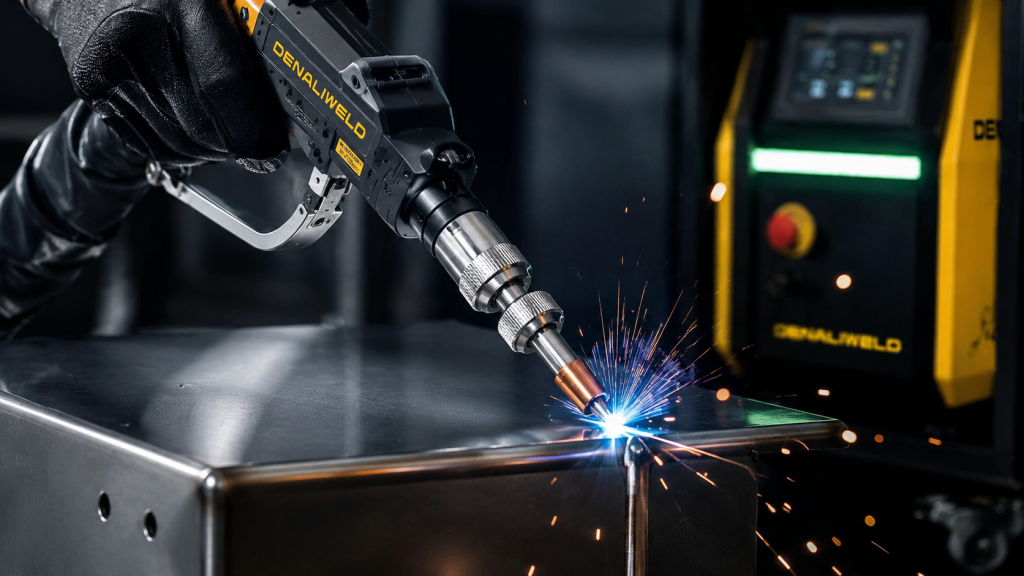
The main types of laser welding techniques include conduction welding, keyhole or penetration welding, pulsed laser welding, continuous wave welding, hybrid laser arc welding, handheld laser welding, and robotic laser welding. Denaliweld’s guide to types of laser welding gives a broader look at these process categories.
Conduction welding uses controlled surface heating. It works well for thin sheets, visible seams, and parts that cannot tolerate deep penetration.
Keyhole welding uses higher energy density to form a deeper, narrower weld. It suits thicker joints or parts that need stronger penetration.
Pulsed laser welding delivers energy in short bursts. It is useful for thin, delicate, or heat-sensitive components.
Continuous wave welding uses a steady beam. It fits longer seams, repeatable weld paths, and higher-speed production.
Hybrid laser arc welding combines laser energy with an arc process. It can improve gap tolerance and allow filler metal use.
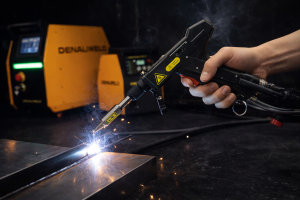
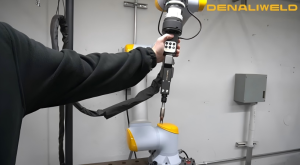
Handheld and robotic laser welding describe how the process is applied. Handheld systems support flexible manual work, while robotic systems support automated, repeatable production.
How Laser Welding Techniques Compare in Speed and Accuracy
Laser welding methods differ in speed and accuracy because each method controls heat, power, focal position, travel speed, and motion differently. Denaliweld’s explanation of laser welding parameters is useful here because power, speed, and focus shape penetration, distortion, and consistency.
Faster travel speeds can improve throughput and reduce heat input. However, speed without enough power or proper focus can leave shallow fusion.
Slower speeds can improve penetration, but they may add heat, distortion, or burn-through risk. Accuracy also depends on fit-up, fixturing, beam stability, and operator or robot control.
Technique | Speed | Accuracy | Best Use | Main Tradeoff |
Conduction | Low to moderate | High | Thin parts, visible seams | Limited penetration |
Keyhole | High | High with control | Deeper welds | Sensitive to setup |
Pulsed | Low to moderate | Very high | Small or delicate parts | Slower on long seams |
Continuous wave | High | High | Long, repeatable seams | Heat buildup risk |
Hybrid laser arc | Moderate to high | Moderate to high | Gaps or filler needs | More variables |
Handheld | Moderate | Operator-dependent | Flexible shop work | Training required |
Robotic | High | Very high | Repeatable production | Higher setup needs |
Benefits and Downsides of Different Laser Welding Methods
The benefits of different laser welding methods include cleaner seams, lower distortion, faster cycle times, precise heat control, and easier automation. The downsides include higher equipment cost, stricter safety needs, tight joint fit-up, and greater sensitivity to settings.
Conduction welding is clean and controlled, but it is not the best choice for deep structural welds. Keyhole welding creates deeper fusion, but poor focus, speed, or shielding can affect quality.
Pulsed welding gives strong heat control for delicate parts. Its drawback is lower productivity on long seams. Continuous wave welding is faster and consistent, but thin or sensitive materials may overheat if parameters are not tuned.
Hybrid laser arc welding helps when joints have gaps or require filler. It also adds complexity because both the laser and arc sides must be managed.
For flexible fabrication, handheld laser welders can support cleaner seams, portability, and reduced rework. They still require correct training, PPE, and laser safety controls.
For production lines, robotic laser welding can improve repeatability and cycle time. The tradeoff is planning. Fixturing, programming, safety layout, and integration must be handled before the system pays off.
Laser Welding Compared With Other Welding Methods
Laser welding is often chosen when a project needs speed, accuracy, low distortion, and clean appearance. An industry overview of laser welding notes that the process uses a focused beam and can be automated for high-precision or high-volume work.
Compared with MIG/GMAW, laser welding can produce narrower, cleaner welds with less spatter and less heat distortion. MIG/GMAW can still be more forgiving for wider gaps, thicker sections, and less precise fit-up.
Compared with TIG/GTAW, laser welding is often faster once the setup is correct. TIG/GTAW remains valuable for careful manual control and specialized work, but it depends heavily on operator skill.
Traditional arc welding still has a place. It may be better for heavy, irregular, outdoor, or repair work where rugged flexibility matters more than narrow heat input.
How to Choose the Right Laser Welding Technique
Choose the laser welding technique by starting with the part, then the production goal.
Decision Guide:
Thin, visible, or heat-sensitive part → conduction or pulsed welding.
Need deeper penetration or long seams → keyhole or continuous wave welding.
Joint has gaps or needs filler → hybrid laser arc welding.
Short runs or varied weld locations → handheld laser welding.
Repeatable production and tight consistency → robotic laser welding.
Also check the practical limits. Poor fit-up, contamination, incorrect focus, and weak safety planning can reduce weld quality even with a strong machine.
FAQs About Laser Welding Techniques
What are the main types of laser welding techniques?
The main types are conduction, keyhole, pulsed, continuous wave, hybrid laser arc, handheld, and robotic laser welding.
Which laser welding technique is best for speed?
Continuous wave and robotic laser welding are often strongest for speed because they support steady motion and repeatable seams.
Which laser welding method is most accurate?
Pulsed and robotic laser welding are often the most accurate when the part is well-fixtured and parameters are correct.
What are the benefits of pulsed laser welding compared with continuous wave welding?
Pulsed welding gives tighter heat control. Continuous wave welding is better for faster, longer seams.
What are the main downsides of laser welding?
The main downsides are cost, fit-up sensitivity, safety requirements, and the need for careful parameter control.
How does laser welding compare with MIG and TIG welding?
Laser welding is often faster and cleaner. MIG and TIG may still be better for some thick, irregular, or manual jobs.
Conclusion: Choosing the Right Laser Welding Method
Laser welding techniques differ because they manage speed, heat, penetration, and accuracy in different ways. Thin or delicate parts may need conduction or pulsed welding. Deeper joints may need keyhole or continuous wave welding. Flexible shops may benefit from handheld systems, while repeatable production may call for robotic welding.
To make the best choice, match the method to the material, joint fit-up, safety plan, and production goal. Explore Denaliweld resources or speak with Denaliweld about choosing a laser welding setup for your application.