

It is 2026, and the manufacturing industry has been more competitive than ever. Leading-edge precision, innovative technologies, and top-notch performance are now at the centerstage of industrial success. And in the art of welding, cobot laser welder systems step up as the top choice among modern firms to keep their edge.
In this article, we guide you in selecting the best cobot laser welders for a safer, more efficient, and more productive automated welding system for maximum ROI.
Key Features Differentiating Cobot Laser Welders
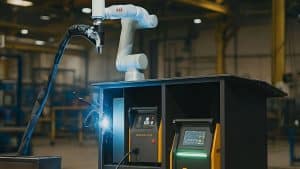
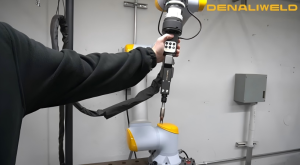
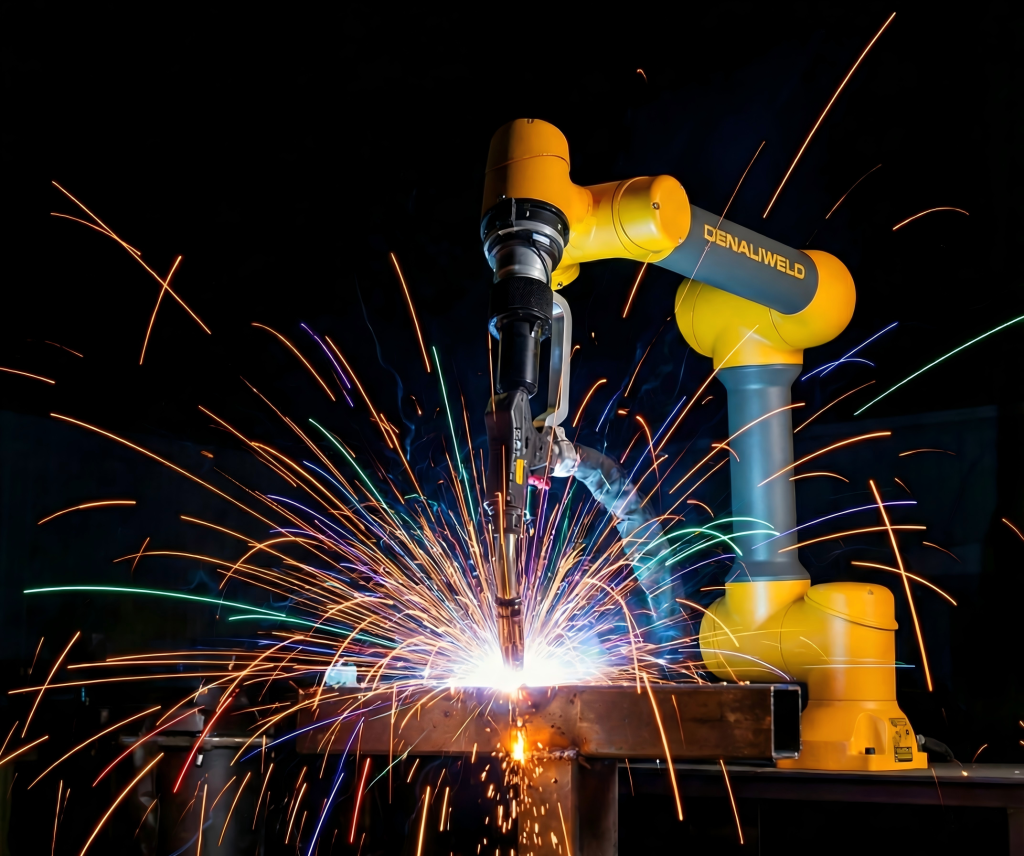
Cobot laser welders are characterized by a uniform configuration. They fuse metals using a highly-concentrated laser beam, which is operated by a collaborative robot arm (cobot) with a laser welding head that can automate repetitive and high-precision welding tasks.
Yet, the performance and capabilities of these machines can be differentiated according to several factors and features.
For instance, the payload and reach of the machine define the limits in robot laser welder use. A unit rated at 5 kilograms with 917-millimeter reach is best applied when dealing with light sheet metal, thin stainless panels, and small fixtures. A model rated at 16 kilograms with 2000-millimeter reach supports thick steel parts, long frames, and multi-side access. Furthermore, higher machine payload allows larger welding heads, wire feeders, and seam tracking sensors.
Another point of comparison is the repeatability of the operations performed by these machines. Repeatability separates entry cobot welders from production-ready assets. A cobot that is rated at ±0.02 millimeters holds a tighter weld path than one rated at ±0.05 millimeters. This precision level can easily control bead width, fusion depth, and gap bridging on thin-gauge parts. Sufficient repeatability and consistency of the machine also support stable penetration on aluminum and stainless steel, where heat input is required to stay stable.
Some machines are also defined by their modular architecture. A cobot with a modular design improves flexibility across product lines. Furthermore, quick tool change plates allow fast swap between the welding machines’ wobble heads, standard nozzles, and cleaning tools. There are also units that come with a one-click manual or auto mode switching features that support fast setup, seamless teaching, and batch production without complex menus.
Technical Specifications Comparison
As a premier provider of laser welding solutions, Denaliweld offers cobot laser welders with premier flexibility, a user-friendly interface, and pinpoint accuracy. To date, Denaliweld offers three cobot models with the following technical specifications.
Model | Max Load | Reach (mm) | Repeatability | Max Speed (m/s) | Power (W) | Weight (kg) |
Denbot5-910 | 5kg | 917 | ±0.02mm | 3.6 | ~200 | 22 |
Denbot10-1300 | 10kg | 1300 | ±0.03mm | 3.8 | ~400 | 37.8 |
Denbot16-2000 | 16kg | 2000 | ±0.05mm | 3.5 | ~600 | 60 |
All of the cobot models above come with extreme installation flexibility that is compatible with ground, inverted, and cantilever setups. They also feature Input/Output ports for seamless factory production integration. And for real-time adjustments in the laser welder’s precision controls, these machines feature optional seam tracking and GCR welding heads.
Integration and Ease of Use
Cobots are widely known for their ease of use and integration into the production facility. Hence, consider the following configurations and aspects when considering a cobot for your welding projects.
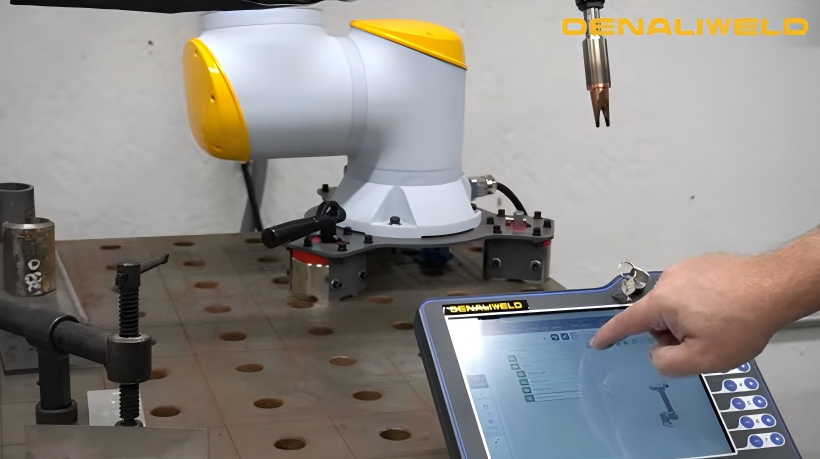
Seek for user-focused controls that can shape daily output in automated welding cells. For instance, machines with clear touch interfaces with large icons can reduce input errors and cut setup time. Moreover, the presence of logical menu paths can guide operators from material choice to weld mode without hidden or unnecessary steps. You can also consider units with color-coded status lights that show “ready”, “weld”, and “fault” states at a glance.
Meanwhile, a unit with at least a 10.4-inch touchscreen pendant with clear icons and guided prompts can enable faster and simpler setup. It is also helpful to consider models that have pre-set parameters for stainless steel, carbon steel, and aluminum reduce guesswork. Another advantageous aspect is the presence of one-click start functions that allow new operators to launch weld cycles with low risk.
Generally, a hybrid of automated-manual operation transitions is preferred for maximum welding efficiency and effectiveness. For instance, native support for Denaliweld air-cooled lasers and Denaliweld water-cooled lasers supports flexible power scaling across thin and thick materials. With one-click switching, the operator can easily transition between Cobot and robot automation using the state-of-the-art DENALIWELD ROBOX system.
Real-World Applications and Performance
Cobot laser welders are often applied in the fabrication of products that are made of stainless steel and aluminum. In these material types, heat control shapes final quality, so a welding solution like cobot welding is essential to achieve pinpoint accuracy.
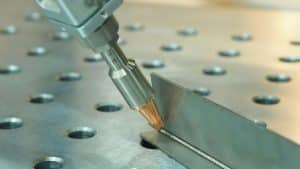
Meanwhile, a tight laser beam focus produces smooth seams with low spatter and minimal warping. It is possible to achieve productivity gains of at least 40% after switching from traditional TIG to automated laser welding systems. This is due to faster travel speed and reduced cleanup. Moreover, clean weld beads often remove the need for grinding or post-polish, which saves labor hours and protects surface finish on visible parts such as railings, cabinets, and food-grade assemblies.
A single cobot cell can also handle multiple tasks in custom metal shops, like fusing thin decorative panels and structural frames. Meanwhile, production lines that demand variation in part size or joint type benefit from programmable paths that cobots can offer. They can adapt even without large fixture changes.
Why Denaliweld Cobot Welding System Stands Out
Denaliweld prides itself on being a provider of cutting-edge solutions in the laser welding industry. The company’s independent research and development determines the quality and performance of current Denaliweld units and systems, which is currently applied in a wide-range of industries such as automotive, aerospace, medical equipment production, and general metal fabrication.
This brand ensures sophisticated in-house design of robot arms, motion control boards, and welding software, which creates tight alignment between hardware and code. This high-level engineering avoids mismatch issues that often appear in subpar and mixed-brand setups.
Denaliweld also ensures full compatibility across models and allows shared spare parts, unified programming logic, and smooth upgrades as production grows. Furthermore, Denaliweld units are designed to have low maintenance architecture that reduces wear on joints and drive systems, which lowers service and maintenance frequency.
All Denaliweld units also passed SGS, CE(MD, EMC), WPQR certification &c test, which testify to the remarkable quality and consistency of Denaliweld cobots’ welding performance.
Buying Guide: Which Cobot Laser Welder for You?
Markets offer dozens of cobot laser welders out there. Yet, you only need to pick one that meets your specific needs.
For small parts, the lightweight Denbot5 provides leading-edge precision and ease of use. But if your projects involve large and complex assemblies, the heavy-duty Denbot16 provides the power and durability required for demanding tasks.
Remember that the selection process does not rely solely on technical specifications. You can also perform live demos to verify if the machine meets your project’s performance expectations. With this option, you can easily spot if the machine comes with limitations that may be disadvantageous to your production system.
Choose the Innovative Power of Denaliweld’s Cobot Welding System
Cobot laser welders are not created equally. Some surpass the others in terms of precision, flexibility, and ease of use. There are those with stronger technical specifications, while some have an edge in intuitive controls and seamless integration features.
But whatever cobot welder you end up choosing, only one thing matters – your chosen unit must meet your production needs.
In Denaliweld, it is our aspiration to offer manufacturers cobot laser welding solutions that can propel their production quality and efficiency. With four branches and more than 150+ dealer stores around the world, it is our commitment to offer tailored and competitive laser weld solutions for various industries. Visit Denaliweld Today.