

Introduction
A robot can repeat a programmed path accurately and still miss the real weld joint. Cutting tolerance, forming variation, fixture wear, loading differences, and thermal movement can shift the seam away from the coordinates used during teaching. That matters more in laser welding because the focused beam has a narrow process window for lateral error. Laser seam tracking closes the gap between nominal geometry and actual part position. A sensor locates the seam, the control system converts that measurement into the robot’s coordinate system, and the weld path is corrected before or during motion.
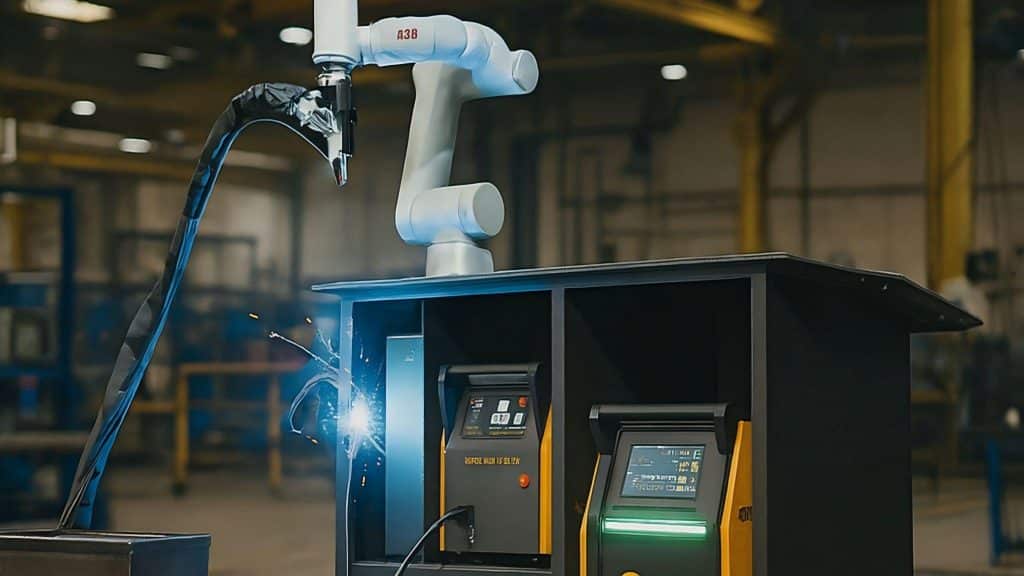
How seam tracking works in robotic laser welding
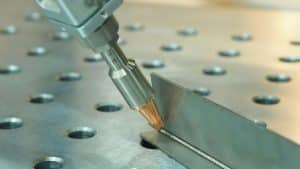
A robotic weld seam tracking system has four functional parts: sensing, feature detection, coordinate conversion, and motion correction. Vision cameras, laser-line profilers, or other optical sensors identify a repeatable feature such as a butt-joint edge, groove, corner, or gap boundary. The system then converts the detected feature into a seam position relative to the welding head and robot.
Seam detection before and during welding
Pre-weld detection is used to confirm the starting joint and, in some systems, scan enough of the seam to create a corrected path before the laser fires. In-process sensing measures the joint while the robot is moving. Research on real-time seam tracking for robotic laser welding shows how sensor data can be added to the robot trajectory so the focal point follows the measured seam rather than only the taught one.
From position error to path correction
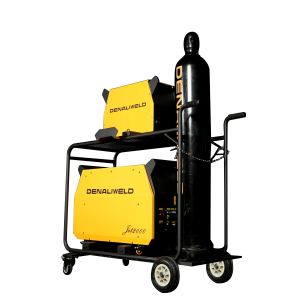
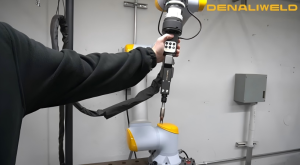
The measured seam location is compared with the nominal trajectory. The controller calculates lateral, vertical, and where supported angular offset, transforms that error into robot coordinates, and updates the path within defined correction limits. Correction needs to be smooth: abrupt motion can create its own weld defect. DenaliWeld’s Robotic Laser Welding System and COBOT Laser Welding System are offered with optional seam tracking, alongside controls for preset welding parameters and process data monitoring.
Why part variation creates tracking problems
Part variation does not need to be large to matter. A stamped panel can move slightly between batches, a formed edge can spring back, a locator can wear, or an operator can load a component against the fixture with a different contact condition. A focused laser spot can move off the joint root with relatively small positional error.
Seam tracking is most valuable when the joint moves enough to defeat fixed coordinates but remains visible and measurable. It is less useful when the part is unstable or the gap is outside the qualified welding window. Tracking can move the beam to the seam; it cannot create missing material or hold a loose workpiece in place.
Seam tracking does not replace fixturing
Fixtures still control gross position, joint gap, orientation, and part stability. Tracking deals with the remaining positional variation. A good engineering target is therefore a stable fixture plus a correction system sized for the variation that remains after clamping, not a weak fixture followed by a sensor expected to recover everything.

Real-time monitoring and weld accuracy
Laser inspection can be used for real-time monitoring during welding, but it is important to distinguish monitoring from final acceptance. Optical sensing can report seam position, measured gap or profile features, correction magnitude, and whether the joint is drifting outside expected limits. Separate process sensors can monitor power, timing, or weld-region behavior.
Keeping the beam centered supports more consistent fusion geometry, penetration, and bead placement because the energy enters the joint where the procedure expects it. It also reduces unnecessary re-teaching when normal part variation is the problem rather than the robot program itself.
What real-time data can reveal
Tracking data can show whether a seam is consistently offset in one direction, which may indicate a fixture or loading issue. Gap measurements can flag where the joint is leaving the validated process window. Logging that information also gives quality and maintenance teams a useful record for troubleshooting recurring defects.
Precision depends on the full system
Sensor resolution is only one factor. Calibration, lens cleanliness, robot repeatability, image-processing time, network delay, joint visibility, surface reflectivity, mounting stiffness, and the distance between sensor and weld point all influence tracking performance. The best results come when sensing is engineered into the cell from the beginning rather than added after commissioning as a stand-alone accessory.
When seam tracking adds the most value
Seam tracking earns its keep in applications where part variation is normal, measurable, and costly to handle by re-teaching. Typical examples include formed or stamped parts, long curved seams, high-mix automated production, and cells where fixtures change regularly.
The benefit is smaller on rigid, precision-machined components held in highly repeatable fixtures with short seams and little batch variation. In that case, the added sensor may create complexity without solving a real problem. The decision should be based on measured seam deviation from existing parts. If the observed variation repeatedly approaches the lateral process tolerance, tracking has a clear engineering purpose.

Developments in automated laser welding
Recent development is focused on tighter integration between sensing and motion. Higher-resolution optical sensors, faster processing, inline gap measurement, and adaptive beam oscillation allow the cell to respond to more than a simple left-or-right seam offset. A 2024 robotic laser welding study on seam tracking and gap bridging combined image-based seam information with path correction and adaptive welding behavior so the system could respond to both seam position and changing gap conditions. A 2026 study on vision-based seam tracking and gap estimation reflects the same direction: measuring joint geometry as well as position so automated cells can react to normal manufacturing variation with less manual re-teaching.
The other direction is faster beam positioning across larger work areas. DenaliWeld launched a robot-integrated Galvo Laser Welding System in 2026 that combines robotic motion with galvanometer beam scanning for high-speed, non-contact precision welding. Galvo scanning is not a replacement for seam tracking, but it shows how automated cells are combining motion platforms, beam control, and process monitoring more tightly.
Conclusion
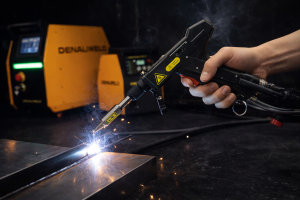
Seam tracking is useful when a robotic laser welding cell needs to follow the real joint rather than assume every part matches the taught path. The system connects seam detection, position measurement, coordinate conversion, and controlled path correction so beam placement stays inside the validated process window. It does not replace accurate parts or sound fixturing. DenaliWeld offers optional seam tracking on its automated welding platforms. For shops that want a mobile source today with an automation path later, the Air-Cooled Laser Welding Machine is an automation-ready option within the same product family. For project-specific integration questions, contact DenaliWeld.
FAQs
Can laser inspection be used for real-time monitoring during welding?
Yes. Optical sensors can monitor seam position, joint geometry, correction amount, and other process-related signals while welding is in progress. That information can flag drift before the cycle is complete. Real-time monitoring supports control and troubleshooting, but final weld acceptance still depends on the inspection method and criteria defined for the part.
How does laser seam welding ensure strong and precise joints?
Precision comes from keeping the focused beam correctly positioned on a prepared joint while power, speed, focus, and shielding remain within the qualified process window. In automation, seam tracking can help maintain that position as parts vary. Joint strength still depends on penetration, fusion area, material condition, defect level, and load path.
What is seam tracking in robotic laser welding?
Seam tracking is a closed-loop positioning function. A sensor detects the actual weld-joint location, the controller compares it with the programmed path, and the robot receives a bounded correction so the laser head follows the real seam. Systems may perform this scan before welding, during welding, or use a combination of both.
When is seam tracking necessary in an automated welding cell?
It becomes valuable when measured part or fixture variation is large enough that a fixed taught path can move the laser outside its validated positional tolerance. Long curved seams, stamped or formed parts, changing fixtures, and high-mix production are common cases. Highly repeatable machined parts may not justify the added system complexity.
What are the latest innovations in automated laser welding systems?
Current development includes higher-resolution optical sensing, faster in-process path correction, inline gap measurement, adaptive beam oscillation, better process-data logging, and tighter integration between robot motion and beam steering. Robot-plus-Galvo systems are also expanding the usable work area while supporting high-speed precision welding on repeat production parts.