

Introduction
A robot can follow the same weld path on every cycle while the finished bead still varies. One possible cause is filler delivery: the wire arrives unevenly, enters the pool in the wrong position, or starts feeding before the process is ready. A laser welder wire feeder therefore belongs in the welding recipe alongside beam settings and robot motion.
Its job is to deliver the required filler consistently through the entire seam. Understanding that delivery chain helps engineers choose a configuration, investigate faults, and establish what the feeder must prove before the cell enters production.
What a Laser Welder Wire Feeder Adds to the Process
Autogenous laser welding joins the base material without adding filler. A wire fed laser welder introduces additional metal into the pool where the joint requires it. Filler can help accommodate an approved gap range, build the required bead shape, or adjust weld-metal composition through a suitable alloy choice.
That flexibility has limits. TWI’s guidance on fit-up tolerance identifies wire feeding as one way to improve gap bridging, but also describes a possible reduction in travel speed and an increase in the heated area. More filler does not automatically produce a faster cycle.
The joint still needs stable positioning and a qualified process. Wire cannot correct a beam placed beside the seam or parts that move during welding. The starting decision is whether the application needs added metal at all. If close-fitting parts already produce an acceptable autogenous weld, a feeder adds equipment and consumables that need a clear production purpose.

The Wire Path From Spool to Weld Pool
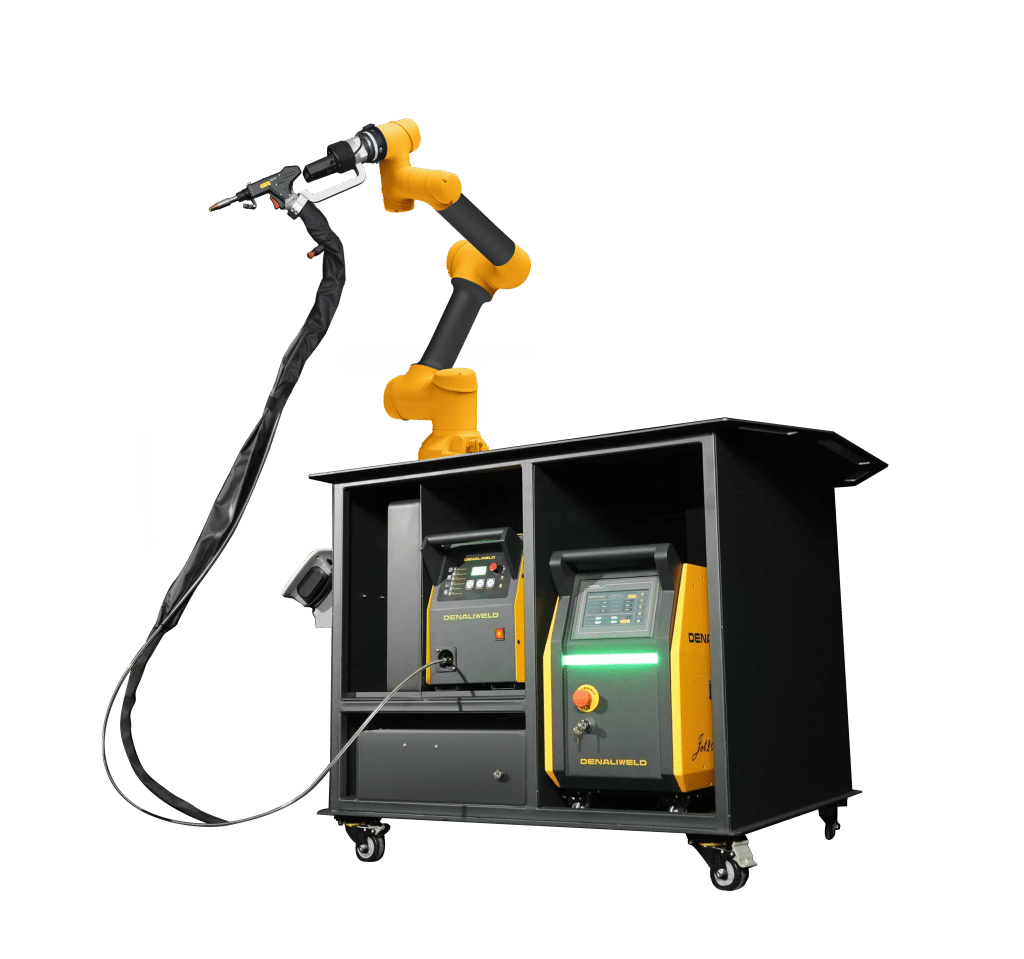
The delivery chain runs from the spool through the drive mechanism, guide or liner, and outlet at the welding head. Spool resistance, drive setup, wire condition, and routing all affect how smoothly filler reaches the joint. The specified wire diameter and material must suit the delivery components.
Routing needs checking through the robot’s full movement. A wire path that works at the home position may bend more sharply when the arm reaches the far side of a fixture. A trial at one position will not reveal that change.
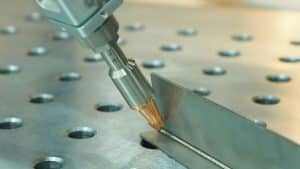
At the head, the wire tip needs a repeatable relationship with the beam and joint. The mounting arrangement must hold that position while allowing the intended approach and travel. Raising feed speed will not solve a wire tip that enters outside the molten pool. Mechanical placement comes before recipe tuning.
The setup record should identify the complete route, including the feeder position and the outlet mounting. That gives maintenance staff a reference when guides are replaced or the equipment is moved, instead of leaving wire placement to be reconstructed by eye.
Single-Wire and Dual Wire Feeder Configurations
Where Single-Wire Feeding Fits
A single-wire setup provides one filler stream and one delivery position to establish. It is a practical starting point when that stream supplies the required volume without exceeding the available melting capacity. Wire diameter and feed rate influence how much metal arrives, while travel speed determines how that volume is distributed along the seam.
Selection should follow the joint rather than the largest wire the feeder accepts. A thin assembly and a joint requiring more fill may need different arrangements. Both must be tested against the required fusion and bead geometry.
When Two Wires May Be Useful
A dual wire feeder supplies two filler streams where the deposition requirement or bead geometry justifies them. Both wires need stable placement and enough energy to melt under the chosen travel conditions. Two wires do not guarantee higher output if the source cannot support the added demand.
Dual-wire feeding differs from push-pull delivery, which assists wire movement along a delivery path. Two drive motors alone do not establish that two wires enter the pool.
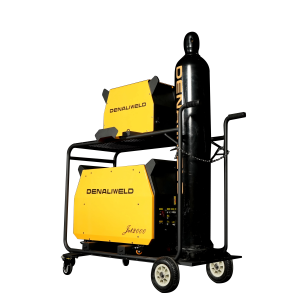
DenaliWeld’s air-cooled laser welding machine page lists dual-wire capability and wire sizes. Some starred designs on that page are scheduled for January 2027. Buyers should confirm the feeder, head, and supported wire range included in their supplied configuration.
A fair comparison uses the same material and acceptance criteria for each configuration. Filler consumption, interruptions, and accepted cycle time reveal whether the extra delivery path contributes enough value to justify its setup and upkeep.
Coordinating Wire Feed With the Automated Cycle
Feed Rate and Robot Travel
At a fixed diameter, changing wire speed or robot travel changes filler volume per unit seam length. Power, beam motion, joint geometry, and shielding must support that combination. A laser welder with wire feed needs a coordinated setup rather than independent settings chosen in isolation.
DenaliWeld’s welding parameter resources include wire speed, feeding delay, and retract fields alongside laser settings. They provide setup context; an automated application still needs validation on its own parts.
Starts, Stops, and Changing Gaps
Timing controls how the first wire reaches the pool and what happens when the seam ends or restarts. These short transitions deserve attention when a part contains several separate welds.
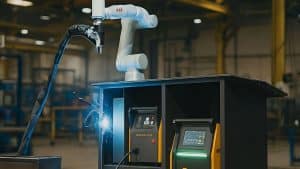
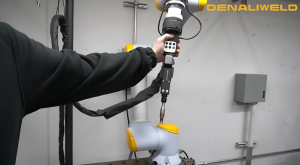
A 2019 University West study demonstrated adaptive filler-rate control using measured gap width. That research supports the approach, not a claim that every feeder includes it. DenaliWeld’s cobot laser welding system provides an automation option, but the required feeder interface and control functions need confirmation for the project.
Delivery Problems That Show Up in the Weld
Changing bead fill is a reason to observe the wire path before altering the weld recipe. Possible mechanical contributors include spool drag, guide wear, an unsuitable drive setup, and a tight bend in the route. These observations identify checks, not a diagnosis from bead appearance alone.
Restart behavior can be tested separately from steady travel. That distinction helps identify whether a problem occurs throughout the seam or only when emission, movement, and feeding begin or finish.
Observation | Possible feeder-related cause | First check |
Intermittent filler arrival | Resistance or slipping in the path | Spool, drive setup, and guide condition |
Delivery changes with robot pose | Routing bends or strain | Wire path through the complete motion |
Wire accumulates ahead of the pool | Placement or recipe mismatch | Tip position and coordinated settings |
Fit-up variation, shielding problems, and beam alignment can produce similar symptoms. Stable delivery should be established before settings are changed, so a parameter adjustment does not conceal a mechanical fault.
What a Production Trial Needs to Establish
Representative parts should cover normal gap variation, different robot poses, restarts, and repeated loading. Record filler consumption, interruptions, cycle time, accepted parts, and rework. One attractive sample cannot establish whether the arrangement will remain useful through a batch.
Inspection follows the joint’s actual acceptance requirements; appearance alone cannot confirm penetration or internal soundness. The equipment scope also needs to identify the compatible head, feeder, controls, and maintenance access.
Automatic delivery does not remove laser exposure hazards. OSHA’s laser-hazards guidance remains relevant to the completed cell, alongside its risk assessment and protective arrangements.
The review also needs an agreed response to an interrupted feed, including how the affected weld is identified and assessed before production resumes.
Conclusion
A useful wire-feeding system supplies the required filler at the right position and time throughout the robot’s movement. Single-wire and dual-wire configurations earn their place through accepted welds, stable delivery, and manageable production requirements.
The decision begins with the joint and ends with a representative trial. Shops can discuss their application with DenaliWeld to review the material, feeder configuration, and automation arrangement. Confirming the supplied equipment and recording the validated setup makes the result transferable from a demonstration to routine production.