

Introduction
Buyers evaluating cobot welding suppliers learn quickly that a demo proves very little. A polished cell running a clean coupon under ideal fixturing says nothing about what happens six months later when a controller board fails mid-run. Choosing among cobot welding companies is not a price comparison. Support depth, integration capability, and training access decide whether the cell earns its keep or sits idle waiting on a part. This article covers how to separate genuine cobot laser welder manufacturers from resellers, which post-sale support structures actually matter, and when working with cobot integrators makes more sense than buying direct. Denaliweld’s cobot welding platform is one direct-manufacturer option worth putting on the comparison list.
Key Features Differentiating Cobot Welding Suppliers
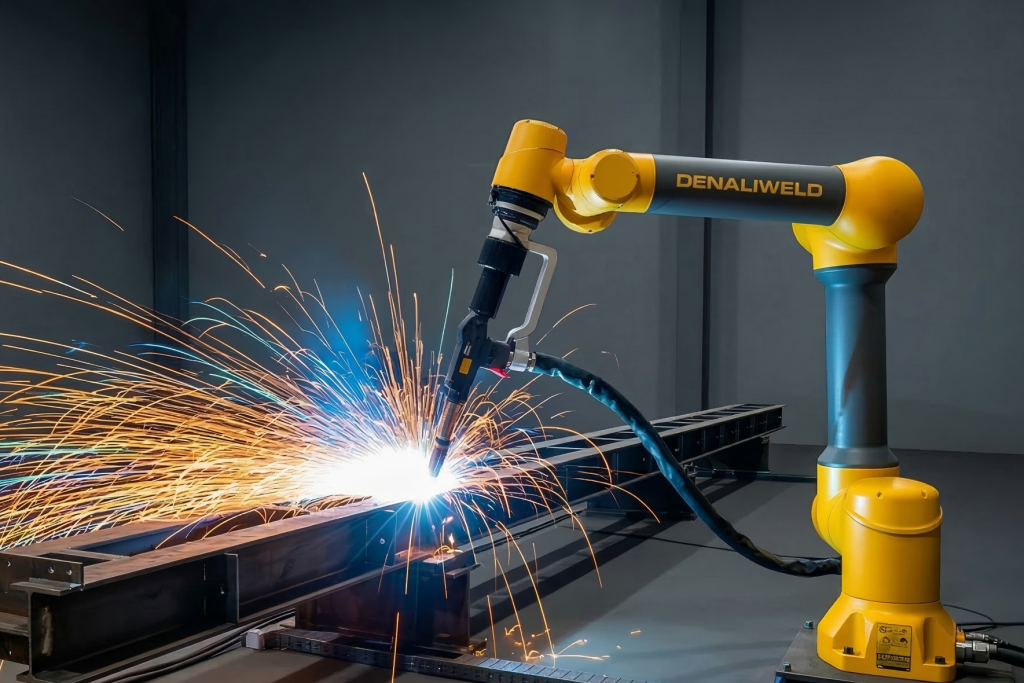
Collaborative robots share a workspace with people rather than sit behind a fence, which is what makes them practical for shops without room for a caged cell. What varies between suppliers is who actually built the system.
A genuine cobot laser welder manufacturer controls R&D, controller design, and laser source integration. A reseller bundles a third-party arm with a third-party laser source and a third-party welding head, then puts its own badge on the assembly. That distinction stays invisible during a demo and becomes obvious the first time firmware and hardware disagree, when a compatibility fault turns into a support ticket bouncing between three companies while your cell sits idle.
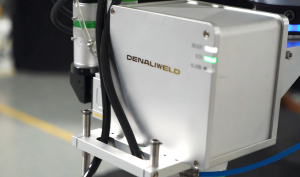
In-house development matters because a unified control architecture makes the hard things routine. Firmware updates roll across the cell instead of one component at a time, and path optimization and real-time power adjustment get tuned together rather than negotiated across an interface nobody owns. Denaliweld develops its welding robots and control systems in house, tests them jointly, and runs the same control system against both air-cooled and water-cooled Denaliweld machines.
The service network is the second differentiator. A supplier with local warehouses, stocked spare parts, and trained technicians can put someone on your floor in days. A supplier routing every request back to an overseas factory measures the same job in weeks, and three weeks of downtime costs more than the price gap that made the cheaper quote attractive. Denaliweld operates four branches and more than 150 dealer stores worldwide, each carrying inventory machines, spare parts, service, and training.
Certification and warranty terms are the third checkpoint. Denaliweld machines carry SGS, CE (MD, EMC), and WPQR certification plus C-Test, with a three-year warranty and free replacement parts for non-human damage. Ask any supplier to put both in writing before the demo, not after.
How to Evaluate Cobot Welding Companies on Support and Integration
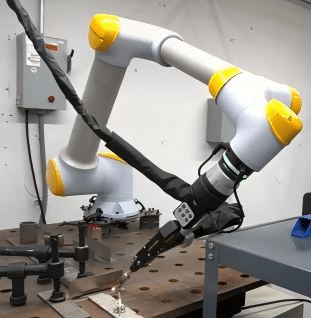
Support is a word every supplier uses and few define. Pin it down before signing. Ask what operator training covers and whether it runs on your parts or theirs. Ask who answers a programming question at six in the morning. Ask for the preventive maintenance schedule, the target response time on an emergency call, and whether software updates are included or billed separately.
Integration depth varies more than most buyers expect. Some shops need a cell producing the day after delivery, with standard fixturing and parts that arrive in the same orientation every time. Others need custom fixturing, line integration, seam tracking, or communication with a PLC that is already on the floor. A supplier that sells one configuration will push your application toward its product instead of the reverse. Denaliweld cobot controllers communicate over TCP/IP, Modbus/TCP, Profinet, EtherNet/IP, CAN, and RS485, with EtherCAT and RS485 available at the end I/O port.
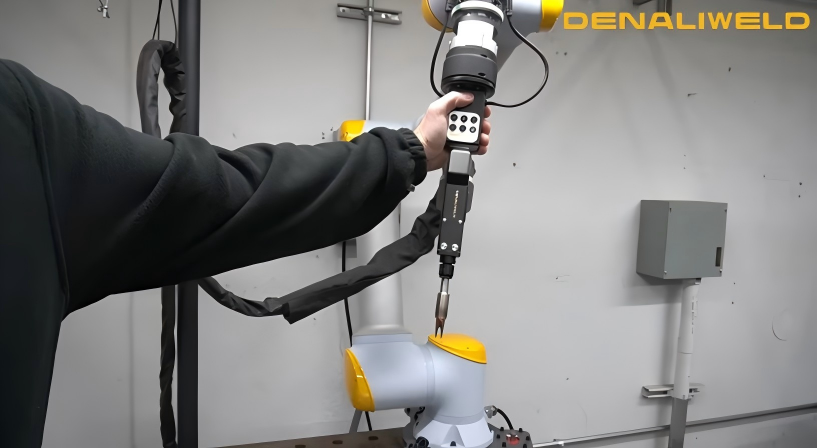
Training accessibility separates a cell that gets used from one the crew works around. Denaliweld systems run on a 10.4-inch teach pendant with pre-set parameters and one-click operation, which shortens the first week considerably. Simple hardware is not a substitute for instruction, though. The supplier should provide hands-on training, written documentation, and a contact who will walk an operator through a new part program without opening a billing code.
Ask about remote diagnostics and data acquisition as well. A cobot welding system should record welding time, power, and speed so engineers can correlate output with quality and catch drift before it becomes scrap. Denaliweld’s welding data acquisition system captures that data for operation tracking and cost calculation.
Cobot Integrators vs. Direct Manufacturers: Which Path Fits Your Shop
Cobot integrators are third-party firms that assemble an arm, a welding source, fixturing, and peripherals into a cell built around one customer’s application. Direct manufacturers sell their own branded system with unified support behind it. Both models work. They fail differently.
Integrators bring flexibility. They can mix brands, adapt an unusual layout, and build around fixturing no standard product accommodates. The tradeoff is accountability. When a weld goes bad and the arm, source, and controller come from three vendors, establishing whose problem it is takes time nobody has. Direct manufacturers give up some of that flexibility and gain a single escalation path, one warranty boundary, and spare parts that match the machine already installed.
Factor | Cobot integrators | Direct manufacturers |
Hardware mix | Multiple brands per cell | Single-brand, unified stack |
Accountability | Split across vendors | One warranty boundary |
Flexibility | High for unusual applications | Configurable within one platform |
Troubleshooting | Coordination across suppliers | Single escalation path |
Spare parts | Sourced per component | Stocked against one platform |
Best fit | High-mix work, multi-brand fleets | Repeatable production, one point of contact |
High-mix job shops with unusual fixturing or an existing multi-brand fleet often do better with an integrator. Shops that want one number to call, predictable spare parts, and training matched to the equipment usually do better going direct. Denaliweld sits in the second category, with integrated controls, ROBOX one-click switching between handheld, cobot, and full robot operation, optional seam tracking, and a modular build meant to keep repairs short.
A Practical Checklist for Choosing Cobot Welding Suppliers
Run every shortlisted supplier through the same six questions.
- Application match.Can the arm reach the joints on your actual parts? Denbot models run from 5 kg payload at 917 mm reach to 16 kg at 2000 mm, and reach constraints stall more projects than payload does.
- Service coverage.How far is the nearest stocked technician, and what is the average response time in writing?
- Training.Hands-on or video, on your parts or theirs, included or billed?
- Spare parts.Which components sit on a local shelf, and what is the lead time for the rest?
- Safety certification.Does the documentation address the force, speed, and workspace limits set out in ISO/TS 15066for collaborative operation?
- Scaling. Can the same source serve a second cell later, or does growth mean starting over?
Then insist on a live demo welding your parts rather than a video shot under ideal conditions. Ask for references from shops with comparable volume, part complexity, and shift patterns, and actually call them.
Conclusion
The best cobot welding suppliers separate themselves after delivery, not during the demo. Support depth, integration clarity, and training access are what distinguish a long-term partner from a one-time vendor, and none of them appear on a spec sheet. Buyers who settle response times, parts stocking, and warranty boundaries before signing avoid most of what makes automation projects stall. For shops planning scalable production, Denaliweld’s cobot welding platform offers self-developed controls, modular construction, and global service coverage, and the broader automated welding solutions overview is a reasonable next stop.