

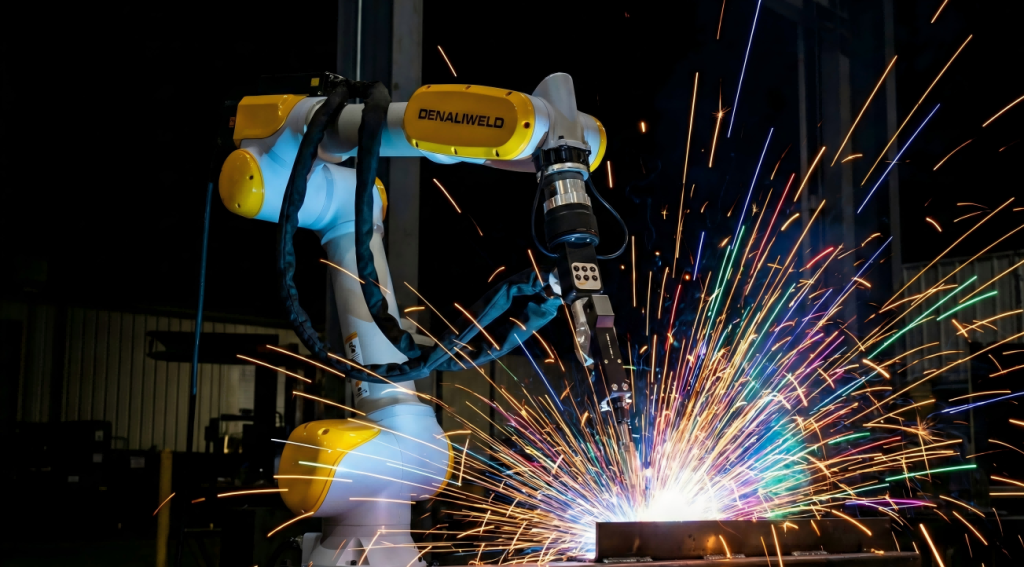
Metal fabrication is an evolving practice with increasing demand. More metal fabrication shops are transitioning away from traditional TIG and MIG methods and toward laser-welding automation. The speed and precision of laser welding technology are benefits that conventional welding methods cannot match.
However, as metal fabrication shops seek to incorporate laser welding productivity into their facilities, they must make a critical decision between handheld laser welding vs cobot laser welding. Even though they are both laser welding solutions, they differ in terms of their speed, flexibility, repeatability, and productivity.
Should your shop invest in a handheld laser welding or a cobot laser welding system? We will explore the differences between the two laser welding automation solutions in this article.
Quick Overview: Handheld Laser Welding vs Cobot
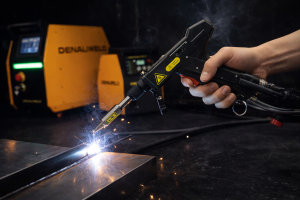
Handheld laser welding is like the innovative successor to the traditional TIG and MIG welding methods. Although it is not a fully automated welding method, some handheld laser welding devices have automated features to control laser beam power and pulse frequency. But you still need to manually move the laser gun to perform the welding.
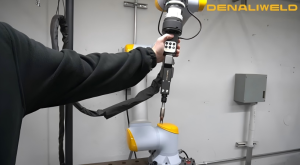
Cobot, which stands for “collaborative robot,” is an automated laser welding technology that uses a robotic arm to perform welding tasks alongside a human worker. The collaborative robot arm is mounted on a wheeled platform, allowing you to move it to different areas of your shop. The arm connects to a fiber-handheld laser source to perform welding as needed.
When Should You Use Handheld Laser Welding?
Handheld laser welding is better suited for small metal fabrication shops with lower-volume production, specialized fabrication projects, and on-site metal repairs. It offers high flexibility and mobility and is much more affordable for a small shop on a limited budget. Let’s examine some best-use cases of handheld laser welding:
Mobility and Flexibility
Handheld laser welding is the most flexible option. If you need to make small on-site repairs or custom fabrications in hard-to-reach areas of a structure, you are better off using handheld laser welding. It is much easier and faster to move around than a cobot welding cell.
Faster Setup and Deployment
Smaller shops transitioning to laser welding for the first time will find it faster to set up a handheld laser welding system. Since you don’t need to deal with the robotic arm and advanced computer software associated with the cobot welding cell, you can avoid the steep learning curve associated with the cobot by choosing the handheld option instead. An experienced welder can learn to use a handheld laser welding device in minutes or hours, rather than weeks.
Handheld Product Recommendation
The DenaliWeld JET 2000 is the perfect handheld laser welding system. It is an air-cooled, compact unit with a lightweight, ergonomic welding gun that fits comfortably in your hand. You can easily adjust the laser position to weld irregular, difficult-to-reach areas of the metal structure for increased precision, without worrying about laser deviation.
When Should You Use Cobot Laser Welding?
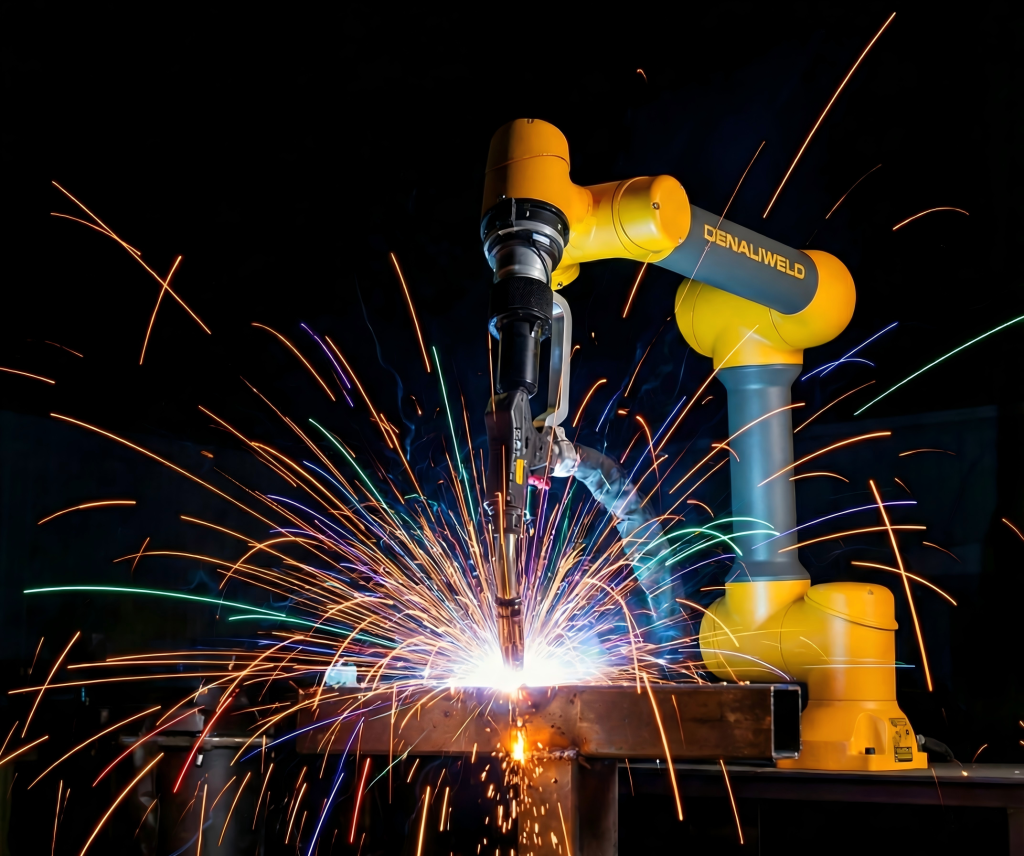
Cobot laser welding is ideal for large and small metal fabrication shops handling a range of projects. A cobot welding cell is an automated, mobile laser welding system that can boost productivity in high-mix production environments where there aren’t enough human workers to sustain manual operation. If you want high throughput and quality consistency, you are better off choosing the cobot laser welding option for your shop.
Precision and Repeatability
No manually operated handheld laser welding device can match the speed, precision, and repeatability of a cobot laser welding system. The cobot offers preset parameters and one-click operation to automate the process and ensure precise, consistent fabrication. The repeatability factor makes cobot laser welding perfect for large-scale production, where precise welds must be executed at the same angle, speed, and distance on every fabrication.
Overcome the Skills Gap
As you probably know, the welding industry is experiencing a severe shortage of skilled workers. Metal fabrication shops are desperate to fill these gaps anyway they can, even if it means using sophisticated cobot laser welding systems. Cobot welding does not require a skilled or experienced welder to run it. All you need is a professional welder to teach someone else how to operate it. After that, the cobot will do most of the work for them. All the human operator has to do is load the parts, push a button, and monitor the progress.
Cobot Welding Product Recommendation
The DenaliWeld COBOT Laser Welding System is the best cobot welding cell option. It offers speed, precision, automation, efficiency, and a user-friendly interface for workers with less experience. The combination of maximum operational flexibility and intelligent design makes it a worthy investment for any fabrication shop looking to take their welding technology to the next level.
Simple Decision Table
Are you still having trouble deciding between handheld and cobot laser welding automation? Here is a simple “Choose This If” table to help you make the right decision for your shop’s specific production needs:
Feature | Choose Handheld If… | Choose Cobot If… |
Batch Size | Low volume (1 to 50 parts) | Medium to High Volume (Over 50 identical parts) |
Part Sizes and Shapes | Highly complex parts of varying sizes | Consistent part sizes and shapes |
Skills | You have skilled welders with good hand-eye coordination. | You have fewer skilled welders and wish to maintain high productivity. |
Mobility | You need to take the welder to the part to make repairs. | You need to take the welding cell to the metal structure or material. |
Budget | You have a small budget | You have a higher budget |
Conclusion
Now you have seen a thorough comparison of handheld laser welding vs cobot laser welding. The best choice isn’t really about laser-welding automation vs. manual. It is really about which laser welding technology is best for your metal fabrication shop.
Achieving high laser welding productivity depends on the specific versatility and customization needs of your fabrication projects. It also depends on your budget since a cobot welding cell is much more expensive than a handheld laser welder. So, with all of that in mind, you should have enough knowledge and insight into both options to make the best choice for your shop.