

Why Cobot Welding Is Now Practical for Small Manufacturers
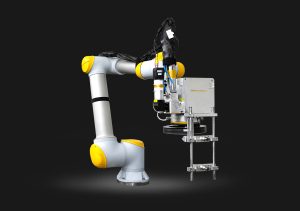
Collaborative welding systems, historically concentrated in high-volume automotive production, are becoming more practical for smaller manufacturers. Metal job shops, contract fabricators, and mold-repair operations are evaluating cobot welding systems to address skilled-labor constraints, improve repeatability, and reduce throughput variability.
Programming has become simpler, system footprints have decreased, and preconfigured packages have reduced integration work. Collaborative systems may use alternatives to full perimeter fencing, but the required safeguards still depend on the complete application and its risk assessment.
Federally supported programs also address manufacturing workforce readiness. Manufacturing USA’s workforce initiatives cover automation and robotics skills, while the ARM Institute provides training and practical automation support through its Robotics Manufacturing Hub.
From automotive plants to job shops
For years, robotic welding was associated with large industrial arms installed in dedicated cells and operated by specialized programmers. That model suited automotive manufacturers and other high-volume operations producing the same parts repeatedly. It was harder to justify in fabrication shops handling short runs, custom work, and frequent part changes.
The International Federation of Robotics identifies welding as a common cobot application and notes that simplified programming and plug-and-play technologies can make collaborative systems more accessible to companies with limited engineering resources. These features are useful in high-mix, low-volume production, where equipment must be reconfigured regularly.
Labor availability is another factor. The U.S. Bureau of Labor Statistics projects an average of about 45,600 openings for welders, cutters, solderers, and brazers each year from 2024 to 2034, largely because workers leave the occupation or the labor force. In suitable applications, cobot welding can move experienced welders toward setup, supervision, and quality control rather than requiring every weld to be completed manually.
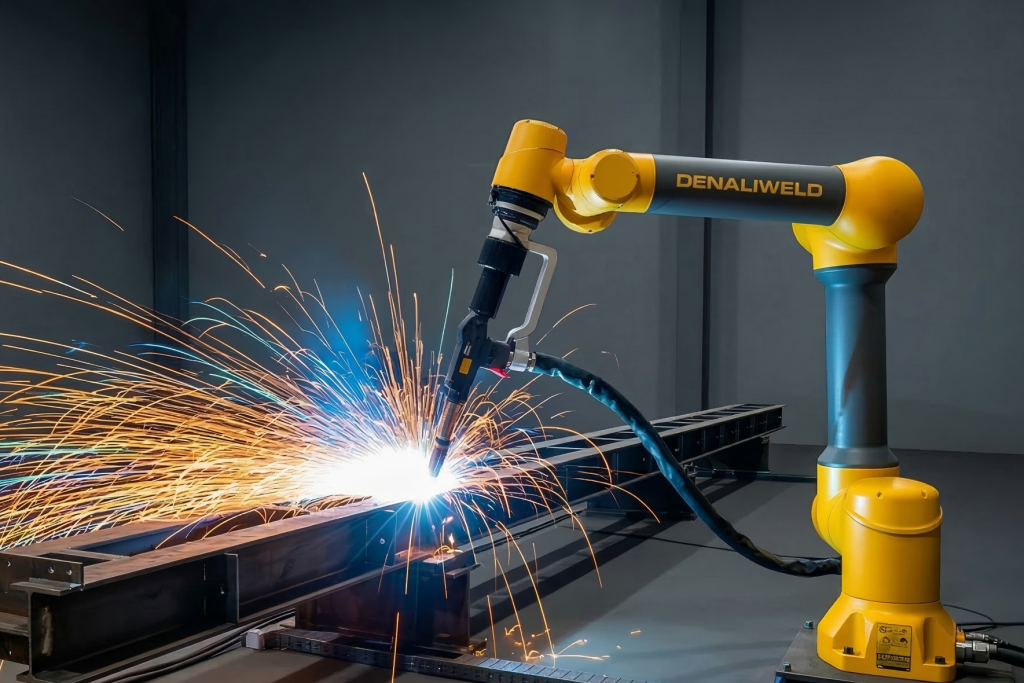
Why cobot welding is more accessible to smaller manufacturers
Several technical changes have reduced the work required to introduce cobot welding.
Simplified programming. Many systems now use graphical interfaces, preset parameters, and guided teaching functions. On systems that support hand-guided teaching, an operator can guide the robot through a welding path, save the sequence, and reuse it for repeat work. Operators still need appropriate process and safety training.
Smaller system footprint. Collaborative systems can fit into more compact layouts than many traditional robotic cells. The safeguards required depend on the robot, welding head, workpiece, motion path, and welding process. OSHA’s robotics guidance notes that collaborative applications may still require guards, light curtains, safety scanners, or other protective systems.
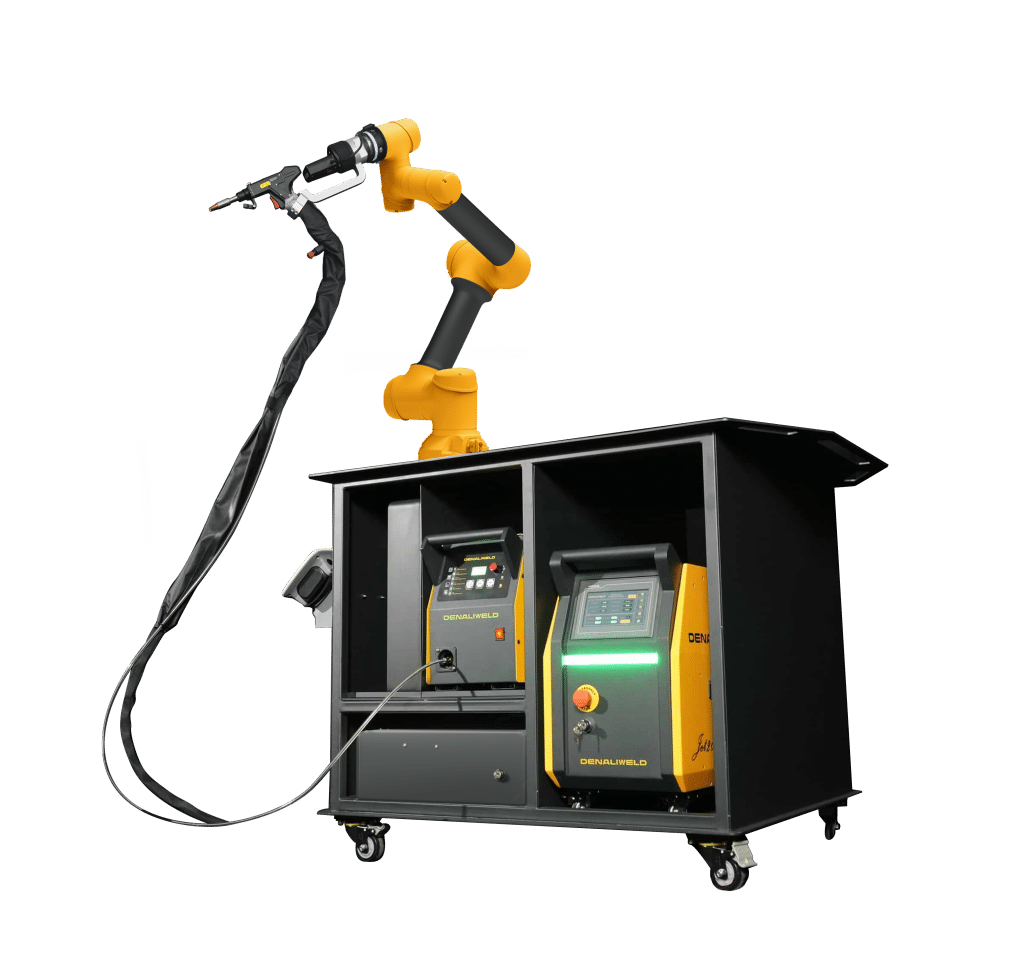
Preconfigured systems. A configured package can combine the robot arm, welding machine, control system, welding head, communication interfaces, and optional tracking equipment. This reduces on-site integration work, although commissioning, application testing, and safety validation remain necessary.
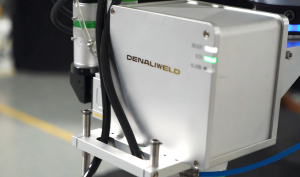
The DenaliWeld COBOT Laser Welding System follows this configured-system approach. It combines a collaborative robot with DenaliWeld welding equipment and controls, supports preset parameters and welding-data recording, and can be configured with optional seam tracking. The platform is compatible with DenaliWeld JET Series air-cooled laser welding machines and water-cooled laser welding machines, and supports switching between handheld and automated welding modes.
How cobot welding differs from traditional robotic welding
Factor | Traditional industrial robot welding | Collaborative robot welding |
Programming | Typically requires dedicated robotics programmer | Graphical interfaces and lead-through teaching; shop-floor staff can learn quickly |
Safety | Full protective enclosures and interlocks | Designed for safe human proximity; often needs only a light barrier or floor mat |
Floor space | Large dedicated cell | Compact footprint; fits alongside existing workstations |
Deployment | Longer integration and commissioning process | Preconfigured cells can reduce integration and commissioning time |
Batch size | High-volume, long-run production | High-mix, low-to-medium volume; frequent changeovers |
Operator role | Separate programmer and welder | Welding operator can program and supervise |
Many job shops and contract fabricators handle custom orders, prototypes, and repair work involving different materials, joint geometries, and quality requirements. Systems that require extensive reprogramming for every part can be difficult to justify in that environment.
The choice is not always between manual welding and a cobot. Shops with frequent changeovers may be better suited to a COBOT system, while stable, higher-volume applications may justify a dedicated DenaliWeld Robotic Laser Welding System. The robotic system combines laser welding equipment, a robotic arm, welding controls, wire feeding, and a dedicated robotic welding head for repeatable automated production.
Applications suited to cobot welding
Preliminary data from the International Federation of Robotics show that U.S. industrial robot installations rose 11 percent in 2025 to about 38,000 units, including approximately 3,000 in the metal and machinery sector. The figures cover industrial robots overall, not welding cobots specifically.
Cobot welding is generally suited to repeatable tasks with stable part positioning and measurable quality requirements, including structural fabrication, equipment components, mold repair, prototypes, and selected aerospace parts. Each application still requires process testing, suitable tooling, and safety validation.
The DenaliWeld COBOT platform supports flexible production and frequent changeovers, while the Robotic Laser Welding System is intended for more dedicated, higher-volume cells. Selection depends on production volume, process stability, floor space, and changeover frequency.